↓ Skip to main content

Calk: Weight on Track · Calorie Counter

How Calk works

Small changes to your usual dishes. Once the changes become habits, you can log food less often and just weigh in.

Free on iPhone, iPhone Duo, iPad and Android

On a diet, on willpower

Plain muesli with yogurt, black coffee, a small portion of buckwheat with chicken and cucumber on kitchen scales, a granola bar with almonds, and plain curd cheese with two crispbreads

1,200 kcal · 600 g of food

Protein67 g60%
Fiber21 g80%

−3.7 kg a month

Fast, and hungry by 9 pm.

Usual day

Almond croissant, vanilla latte with whipped cream, salmon bowl on white rice, beef lasagna and tiramisu

2,200 kcal · 900 g of food

Protein84 g75%
Fiber10 g40%

+0.3 kg a month

Usual meals, and the weight creeps back.

With meal adjustments

The same croissant, a skim-milk latte, Greek yogurt with berries, salmon bowl on quinoa, sauerkraut with cranberries, chicken lasagna, grilled potatoes and peppers, tiramisu with berries

1,900 kcal · 1,500 g of food

Protein116 g100%
Fiber27 g100%

−1 kg a month

More food, fewer calories, and still tasty.

Half of what people log comes from the same nine foods and drinks (Tran, 2026). Adjust your regular dishes once, and the adjustment comes back every time they do. People who keep their new eating habits for years keep more of the lost weight off (Thomas, 2014). A steady routine helps too: eating the same way on weekdays and weekends (Gorin, 2004).

Same on top. Different inside.

You know the recipe. Calk counts it.

400 g each
750 kcal · fiber 3 gWhite rice, sauce and sesame oil
560 kcal · fiber 10 gQuinoa, a spoon of sauce, no sesame oil
310 kcal · fiber 5 gGreens, a spoon of sauce, no sesame oil
250 g each
570 kcaladded sugar 30 gsaturated fat 15 g9% cottage cheese, 2 eggs, butter, extra sugar
490 kcaladded sugar 20 gsaturated fat 8 g5% cottage cheese, 1 egg, sunflower oil, sugar
310 kcaladded sugar 0 gsaturated fat 3 g2% cottage cheese, egg whites, oat flour
300 g each
510 kcal · fat 25 gBeef and béchamel
410 kcal · fat 17 gWhole-wheat sheets, beef and vegetables
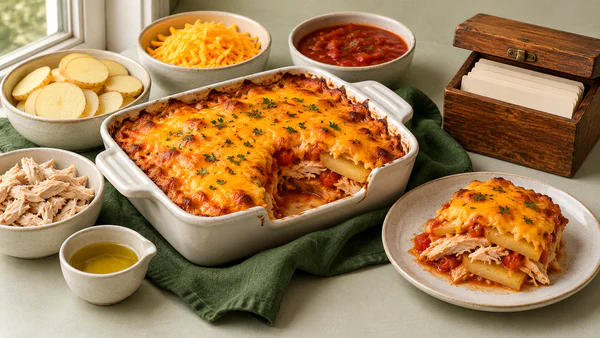
390 kcal · fat 13 gChicken and tomato

The calories sit in the parts: the base, the sauce, the oil, the cheese, the sugar. Calk logs a homemade, restaurant or ready-made dish by those parts. With fewer calories per gram, the same calories fill a bigger plate (Rolls, 2006). Calories in everyday dishes

Log the dish the way you made it.

747 → 453 kcal

Each part you choose brings its own calories, protein, fiber, salt and sugar.

Weigh a new dish once, then use cups, spoons, slices or pieces for calorie counting without weighing.

Change a part. Keep the dish.

Calk reads your meals the way a dietitian or nutritionist would: protein, fiber, saturated fat, added sugar, salt and how much food you get for the calories. Then it suggests changes in the dishes you actually eat.

Try salmon instead of steak, with potatoes, beans and broccoli instead of rice.

Pan-fried steak with white rice next to grilled salmon with potatoes, beans and broccoli on the same plate

550 → 470 kcal · 260 → 400 g of food · fiber 1 → 11 g · saturated fat 14 → 4 g

Try tomato sauce instead of cream in the same chicken pasta.

The same wheat penne, chicken and Parmesan with cream sauce, then tomato sauce, on identical plates

720 → 560 kcal · saturated fat 15 → 3 g · the same 400 g

Try a tomato base instead of coconut milk in your curry, with spinach, peas and a smaller scoop of rice.

Chicken curry in coconut sauce with a large scoop of rice next to a tomato curry with spinach, peas and less rice

340 → 280 kcal · saturated fat 6 → 1 g · the same 250 g

Start with one change. Keep the ones you like.

Liked it? Tap ♥.

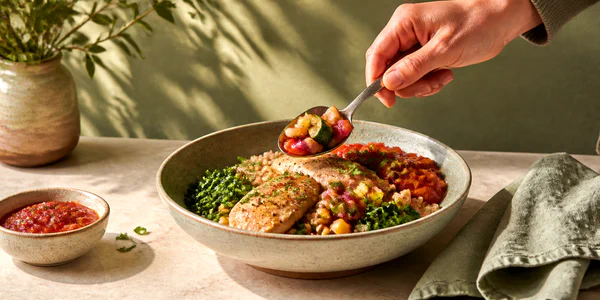
A hand with a green-stone ring holding chicken, quinoa and red tomato salsa in an ivory bowl
Bowl ♥ · chicken, quinoa, salsa, no sesame oil · 453 kcal
Calk meal templates in “Mine”, including Bowl

Next time it opens just like this. Add the template to “Mine” to keep it handy. Log it again in two taps. Change a part with one more.

Twenty oatmeal recipes become one meal template.

200 g of porridge in every bowl

Made with water, thin99 kcal
Made with water, thick188 kcal
Made with milk237 kcal
Made with milk, butter, sugar and raisins405 kcaladded sugar 8 gsaturated fat 9 g

The difference is the water, the milk and the add-ins.

The “Porridge” screen in Calk showing oatmeal thickness, milk and sugar, with totals for calories, protein, fat and carbohydrates
The same “Porridge” screen showing butter and raisins, with totals for calories, protein, fat and carbohydrates
Change any part in a tap. Every version stays one dish, with nothing to save as a copy.

Advice about your dishes, in grams.

Protein increased from 71 to 106 g per day between weeks.
Saturated fat comes from several foods: ground beef, Gouda, mozzarella and other foods.
Fiber across the week, with 20 g of chia seeds adding 7.4 g per portion.

Tap any advice card to enlarge.

Variety map

21 plants and 12 of 14 groups this week, with two groups still emptyAdd variety: natto, kimchi or sauerkraut can add fermented foods to your week
Monthly variety map, with food groups and foods already eaten highlighted

The idea of 30 plants a week is a prompt to widen your usual meals. The variety map shows what you already eat and foods you could add; the nutrition report brings them together in a full map.

Your month shows what to change.

Nutrition report, once a month.

Real nutrition report summary: estimated maintenance calories and macronutrient ranges

Your maintenance. Your macros.

2,097 kcal a day, estimated from logs and weigh-ins. Protein is low; fat is high.

Repeated morning, midday and evening meals, with each food's share

The foods your month repeats.

Butter appears in two meals a day: about 285 kcal. A specific place to try a change.

Once you know your food, you can log less.

Keep weighing in. With “Weight trend alerts” on, Calk sends one quiet notification if your weight trend drifts off course.

Every meal

Learn the meals you repeat.

Only new or changed dishes

Log what's new.

Four months of weigh-ins, daily from Apple Health except a three-week vacation with six weigh-ins entered by hand: downward trend, a stable period, then an upward drift
Food records on the same dates: daily at first, then occasional, a long gap and a seven-day food check after the trend driftNo food logs

Like the detail of protein, salt or vitamins? Keep the diary.

Regular weigh-ins are common among people who keep weight off (Wing & Phelan, 2005).

Holidays and trips: the diary is there when you want it.

Log a festive dinner or a café lunch when you want to see it in numbers. Log restaurant meals by their parts.

Festive dinner.

BeforeAfter
Roast turkey, ham, cheese and bread next to a thinner turkey slice with potatoes, vegetables and salad

A thinner slice of turkey, with potatoes, vegetables and salad in place of the ham, cheese and bread.

740 → 490 kcal · 320 → 450 g of food

Beach holiday.

BeforeAfter
Four pepperoni pizza slices and beer next to two slices with corn, salad, watermelon and the same beer

Two slices instead of four, with corn, salad and watermelon. The beer stays.

1,160 → 870 kcal · 400 → 620 g of food

The holidays add less than half a kilo on average, but that half kilo usually stays and adds up year after year (Yanovski, 2000). Keep weighing in, and the trend shows whether this one stayed.

Start with tonight's dinner.

Save tonight's dinner, and it's ready the next time you cook it.

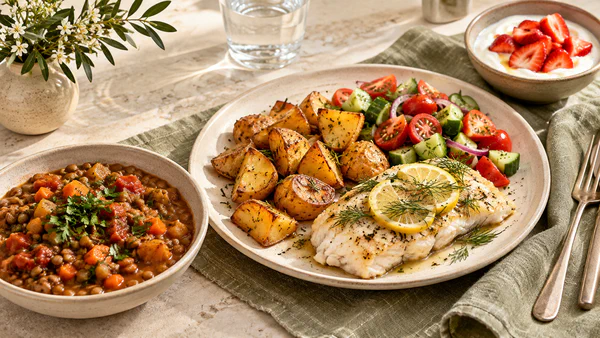
A hand with a green-stone ring beside grilled chicken, roast potatoes, peppers and a green salad for dinner

The core tracker is free, and so is your first month of advice and reports.

Features

Log

Dishes by their parts

Choose a meal template for your dish, set its base, sauce, oil, cooking method and portion, and Calk calculates the whole dish.

Works offline

The food catalog lives in the app, so logging works on a plane, in roaming, anywhere.

Learn

Daily advice on your dishes

About 70 kinds of advice on calories, protein, fiber, salt, sugar and meal times, based on your own meals. Find foods that give you more on the plate for the same calories and keep you full longer. Food suggestions come with specific foods and portions to try. Try the suggestions and keep what works for you.

Weekly variety map

A free weekly map of the food groups you ate, and the ones still missing. See what is already in your rotation and pick a food below the map to widen it.

Nutrition report

Once a month: what your food is short of and which repeating dishes to change. Your maintenance comes from your own logs and weigh-ins; your repeating foods show where a small change can count again and again.

Keep

Weight trend

Your weigh-ins become one smoothed line. With “Weight trend alerts” on, Calk tells you once when it turns away from your goal and stays quiet otherwise.

Pause and come back

Log when you choose and keep weighing in. Come back after a month or a year. Your saved dishes are still there, and the first weigh-in picks up the trend.

Trust

Every dish, its own nutrients

Each dish is calculated from its own ingredients, cooking method and portion, so changing one part recalculates the whole dish.

Ad-free

Calk has no ads and never will.

Seven languages

English, German, Spanish for Spain and Latin America, Brazilian Portuguese, Russian and Hebrew.

Questions

What is Calk?
Calk: Weight on Track is a calorie counter and nutrition tracker for iPhone, iPhone Duo, iPad and Android. A meal template lets you log each dish by its parts, and Calk calculates its calories, macros, fiber, salt, sugar, vitamins and minerals. It suggests small adjustments to your usual meals. As those become habits, you can log less and keep following your weight trend.
What are meal adjustments?
Meal adjustments are small changes to a dish you eat often, such as quinoa for white rice in a bowl or skim milk in a latte. The dish stays familiar, so the change comes back every time you eat it.
Is this a diet?
No. A diet is a set of temporary rules, and when it ends, most people go back to their old meals and the weight comes back. Calk works on the dishes you already eat. You choose the small changes you like, and they stay with you as habits. There is no menu to follow and no forbidden food, dessert included.
Is Calk good for beginners?
Yes. If you are new to calorie counting, start with one dish you cook often and tap through the choices, with no recipe to type. Calk sets your calorie target from your body and activity, and daily advice in the first month helps you understand what to change.
Do I need a kitchen scale?
No, a scale is optional. Weigh a new homemade portion once, then repeat it in grams, ounces, cups, spoons or slices. For a restaurant meal, use the total portion weight from the menu, set it with the gram buttons and adjust the parts to match your plate. Calk remembers each saved portion.
Is Calk free?
Yes. Food logging, calorie and macro targets, weight and trend, and the weekly variety map are free for good. Daily advice and the nutrition report come with an annual subscription. The first month is free, and you can cancel any time in the store’s subscription settings.
Does Calk work on foldable phones?
Yes. On an unfolded iPhone Duo, while you build a dish, the right side shows how it changes your day: before, meal, after. On the home screen, the day’s report sits next to your targets and limits. The fold never covers text or buttons, and if you fold the phone mid-entry, nothing is lost. Calk supports this layout on foldable Android phones too. On iPad and Android tablets, the text is also laid out in two columns.
When do I get my first nutrition report?
Your first nutrition report opens once the last 30 days hold 20 fully logged days of food and 10 days with a weigh-in, so a steady first month brings it free. After that, a subscription gives you a report covering the latest 30 days.
Does Calk count fiber, salt and vitamins in homemade dishes?
Yes. Calk calculates nutrients in homemade dishes from their ingredients and cooking methods. A lasagna or soup includes fiber, salt, added sugar, vitamins and minerals along with calories and macros.
How does Calk compare with logging food by photo or voice?
A photo or a spoken name tells which dish is on the plate, but not the oil in the pan, the sauce under the rice or how fatty the meat is. In published tests of calorie counting by photo, the strongest AI models were off by 20–36% of a dish’s calories, and four consumer apps missed 27–38% of a meal’s calories on average. In Calk you say how the dish was cooked, and the calories come from your recipe.
Coming from MyFitnessPal with hundreds of recipes?
Calk doesn’t import MyFitnessPal recipes. You don’t need to recreate them all before you start. Add your usual dishes as you go and save each mix in two taps. Each variation, such as a different cheese or less sugar, changes the same dish in one tap.
How is a dish edited in MyFitnessPal or Cronometer, and how in Calk?
In Calk the parts stay on screen while you log: changing an ingredient takes one tap, and ♥ remembers the new mix. In MyFitnessPal and Cronometer you edit the saved recipe in the recipe editor; Cronometer can also split a logged recipe into its ingredients. For a detailed comparison, see our articles on MyFitnessPal and Cronometer and our calorie tracker comparison.
Does Calk replace a dietitian or nutritionist?
No. Calk reads your food diary down to ingredients and nutrients and suggests changes to your dishes. Personal assessment, diagnosis and care stay with a qualified professional, and you can bring your nutrition report to a consultation.
What should I do if my weight is up after a holiday?
Go back to your usual meals and keep weighing in. A high reading after a trip is mostly water, and the weight trend shows whether anything stayed. With “Weight trend alerts” on, Calk tells you when a short food check could help. The weight-maintenance guide explains what to follow between food checks.
Can I pause and come back?
Yes. Stop logging whenever you like and keep weighing in. If you are tired of tracking, you can take a break. Your saved dishes stay in Calk, so when you come back, even years later, your usual meals take two taps again. Read about taking a break from food logging.
Where do the numbers come from?
Calk calculates each dish from its ingredients, cooking method and portion, using national food-composition tables, specialist databases and published research. Read how Calk builds and checks its food data. Calk also checks complete dishes against published recipes; see the accuracy test and its limits. The methodology explains the calculations behind targets and reports.

Research

Tran T, Manoogian ENC, Hou ZJ, Varshney S, Sui J, Laing KL, Fleischer JG, Panda S2026The Diversity and Consistency of What and When People Eat
Thomas JG, Bond DS, Phelan S, Hill JO, Wing RR2014Weight-loss maintenance for 10 years in the National Weight Control Registry
Gorin AA, Phelan S, Wing RR, Hill JO2004Promoting long-term weight control: does dieting consistency matter?
Rolls BJ, Roe LS, Meengs JS2006Reductions in portion size and energy density of foods are additive and lead to sustained decreases in energy intake
Wing RR, Phelan S2005Long-Term Weight Loss Maintenance
Yanovski JA, Yanovski SZ, Sovik KN, Nguyen TT, O'Neil PM, Sebring NG2000A Prospective Study of Holiday Weight Gain

All references

Latest articles

All articles

Calk: Weight on Track for iPhone, iPhone Duo, iPad and Android.