- Calk — the calorie counter you don't have to live in/
- Calories in everyday food/
- How many calories are in a yogurt cup?/
Same-portion calorie comparison
How many calories are in a yogurt cup?
Two yogurt cups of the same size can differ by a factor of three. Label sugar and fat set the base, and fruit preparation, granola and honey add the rest. Log the label values and your toppings in Calk.

Same 200 g portion, different choices: type of yogurt, sugar per 100 g, fruit in the product, crunch and dried fruit, sweet, fat content.
What sets one yogurt cup apart from another
In these two examples, the changes are: type of yogurt — greek or skyr → classic, sugar per 100 g — up to 5 g → 16–20 g, fruit in the product — added: lots of fruit, crunch and dried fruit — added: granola, fat content — added: 10%.
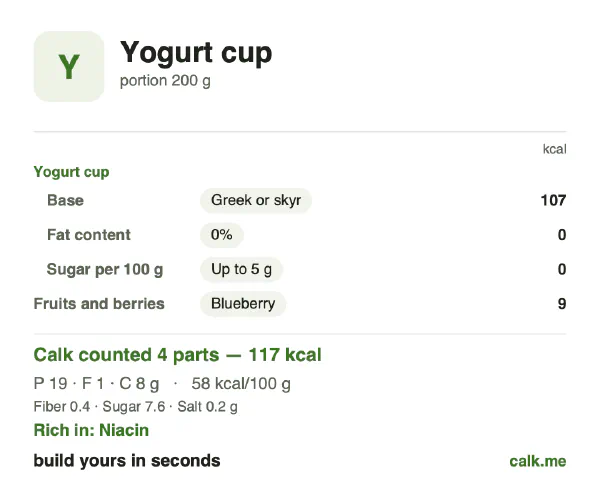
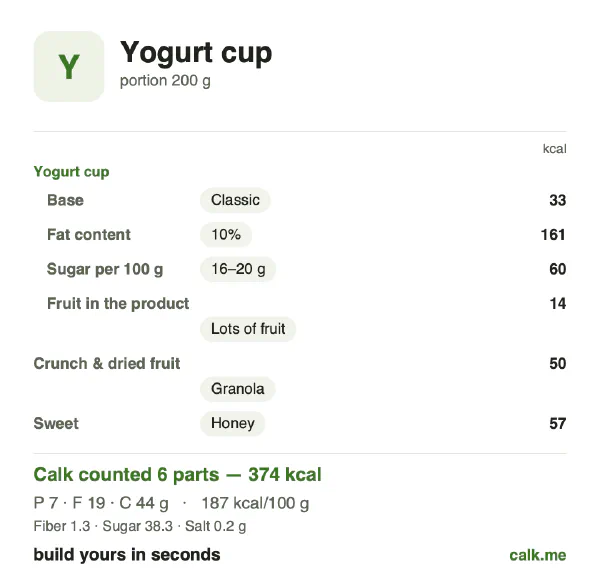
- Sugar per 100 g on the label is the dial: plain Greek yogurt or skyr with a few blueberries has about 4 g, a sweetened 10% dessert yogurt with fruit preparation, granola and honey has about 19 g.
- Protein runs the other way, with about 9 g per 100 g in the plain cup and about 3 g in the dessert one.
- In the same 200 g cup that is about 115 kcal against about 375 kcal.
Greek yogurt, skyr, fruit yogurt and dessert yogurt calories
Calculate calories and macros for a cup of plain, Greek, fruit or plant-based yogurt, choosing the fat content, sugar per 100 g and weight from the label, then adding fruit, granola or honey.
More calorie comparisons for dairy and dessert cups
Learn more
Questions about calories in yogurt cups
How many calories are in a plain yogurt cup compared with a dessert yogurt?
Why does a dessert yogurt have so many more calories than a plain one?
How do I calculate the yogurt cup I ate?
Calculate your own yogurt cup in Calk
Calk is available on iPhone, iPad, and Android.