
- Calk — the calorie counter you don't have to live in/
- Calories in everyday food/
- How many calories are in chicken and rice?/
Same-portion calorie comparison
How many calories are in chicken and rice?
Oil in the wok, sweet glaze, a fried egg and breaded meat can change a rice bowl far more than the rice itself. Add each component in Calk.

Same 300 g portion, different choices: grains, proteins, flavor base, vegetables, fat, sauce, cooking method.
How frying, sauce and toppings change a rice dish
In these two examples, the changes are: flavor base — added: onion, flavor base — added: carrot, sauce — soy sauce → teriyaki glaze, cooking method — deep-fried, cooking method — sauteed.
Lower calorie
341 kcal
300 g
114 kcal per 100 g
higher vs lower calorie
+46%
Higher calorie
499 kcal
300 g
166 kcal per 100 g
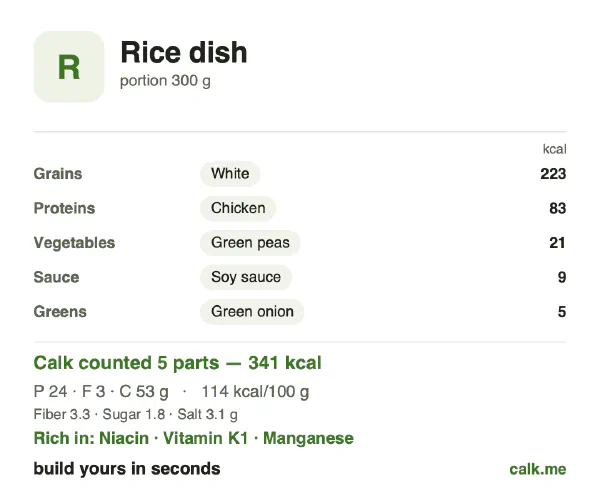
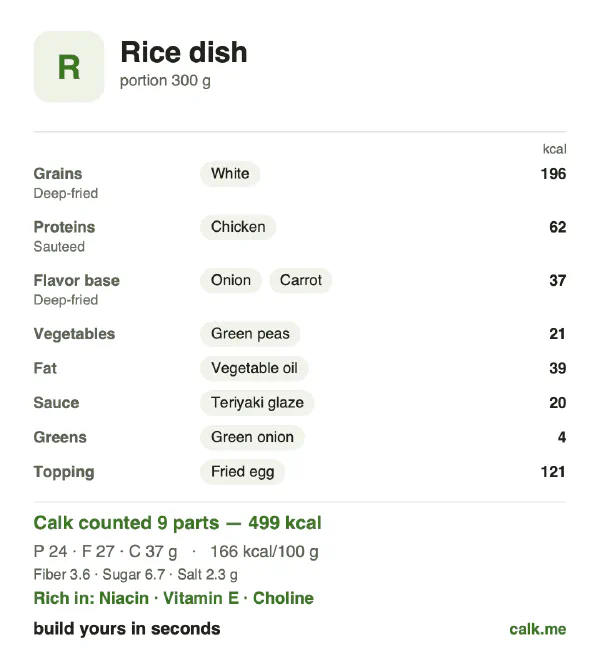
- Fried rice retains cooking oil: plain chicken and rice comes to about 131 kcal per 100 g here, versus 174–185 for teriyaki fried rice and katsudon.
- Takeout additions add up: oil in the wok, a sweet teriyaki glaze, a fried egg on top — each small, together nearly half again the calories.
- Chicken, peas and green onion appear in both bowls.
- Its boiled rice and soy sauce contain much less added fat than the fried version.
Chicken rice, fried rice, katsudon and curry rice calories
Calculate calories and macros for chicken rice, fried rice, katsudon, Mexican red rice, squid-ink rice, ouzi or rice with curry.
Rice dishBlack squid-ink riceChicken fried riceMexican red riceLamb ouzi riceEgg fried riceRice with vegetablesSpecial fried riceFried riceRice & curryRice bowlRice plate
More calorie comparisons for rice dishes
Learn more
Questions about calories in rice dishes
How many calories are in plain chicken rice compared with fried rice?
The two versions shown in Calk contain 341 and 499 kcal per 300 g. Oil in the wok, sweet glaze, a fried egg and breaded meat can change a rice bowl far more than the rice itself.
Why is teriyaki fried rice with egg higher in calories than plain chicken and rice?
Fried rice retains cooking oil: plain chicken and rice comes to about 131 kcal per 100 g here, versus 174–185 for teriyaki fried rice and katsudon. Takeout additions add up: oil in the wok, a sweet teriyaki glaze, a fried egg on top — each small, together nearly half again the calories.
How do I calculate my own rice dish?
Open Rice dish in Calk and enter the cooked rice, protein, wok or frying oil, sauce, vegetables, egg and toppings.
Calculate your own rice dish in Calk
Calk is available on iPhone, iPad, and Android.