
- Calk — the calorie counter you don't have to live in/
- Calories in everyday food/
- How many calories are in stir-fried noodles?/
Same-portion calorie comparison
How many calories are in stir-fried noodles?
A noodle plate changes when vegetables give way to more noodles and when peanut sauce, wok oil and fried toppings pile on. Build the full dish in Calk.

Same 300 g portion, different choices: noodle type, proteins, vegetables, sauce, fat, topping.
How oil, sauce and toppings change noodle calories
In these two examples, the changes are: noodle type — soba → ramen noodles, proteins — chicken → pork, vegetables — cabbage → onion, sauce — soy sauce → peanut sauce.
Lower calorie
335 kcal
300 g
112 kcal per 100 g
higher vs lower calorie
+130%
Higher calorie
770 kcal
300 g
257 kcal per 100 g

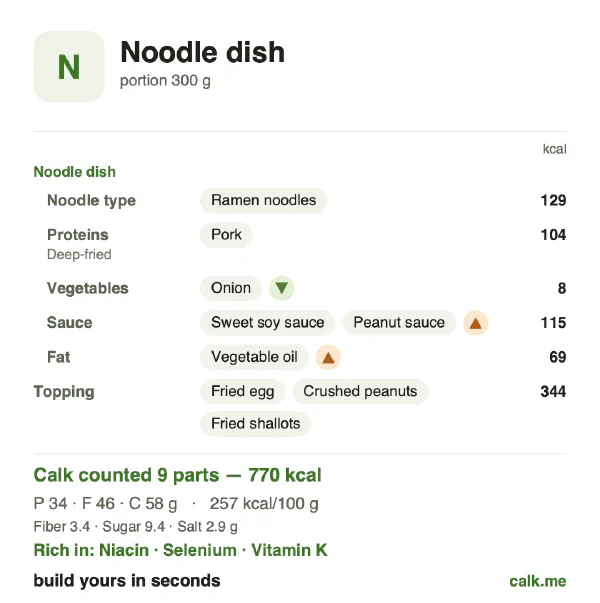
- One plate replaces a fifth of the noodles with cabbage. The other keeps all the noodles and uses more frying oil.
- Soy sauce with garlic and ginger contributes little energy, while the peanut sauce and sweet soy sauce add fat and sugar.
- A fried egg, crushed peanuts and crispy fried shallots go on the second plate.
Soba, ramen, pad Thai and wok noodle calories
Calculate calories and macros for soba, ramen, lo mein, chow mein, pad Thai, dan dan or glass noodles with their protein and sauce.
Noodle dishGlass noodle stir-fryChicken noodle stir-fryDan dan noodlesGlass-noodle saladLo mein noodlesSingapore noodlesMie noodlesGlass noodlesRice noodlesSoba noodlesWheat noodles
More calorie comparisons for noodle dishes
Learn more
Questions about calories in noodle dishes
How many calories are in a chicken soba stir-fry versus pork ramen noodles?
The two versions shown in Calk contain 335 and 770 kcal per 300 g. A noodle plate changes when vegetables give way to more noodles and when peanut sauce, wok oil and fried toppings pile on.
Why are ramen noodles with peanut sauce and fried toppings higher in calories than vegetable-heavy soba?
One plate replaces a fifth of the noodles with cabbage. The other keeps all the noodles and uses more frying oil. Soy sauce with garlic and ginger contributes little energy, while the peanut sauce and sweet soy sauce add fat and sugar.
How do I calculate my own noodle dish?
Open Noodle dish in Calk and enter the cooked noodle amount, protein, vegetables, wok oil, sauces, egg, nuts and crispy toppings.
Calculate your own noodle dish in Calk
Calk is available on iPhone, iPad, and Android.