
- Calk — the calorie counter you don't have to live in/
- Calories in everyday food/
- How many calories are in a hotel breakfast plate?/
Same-portion calorie comparison
How many calories are in a hotel breakfast plate?
At a hotel buffet, fried breakfast foods, pastries and repeat servings can change the meal quickly. Add every plate and refill in Calk.
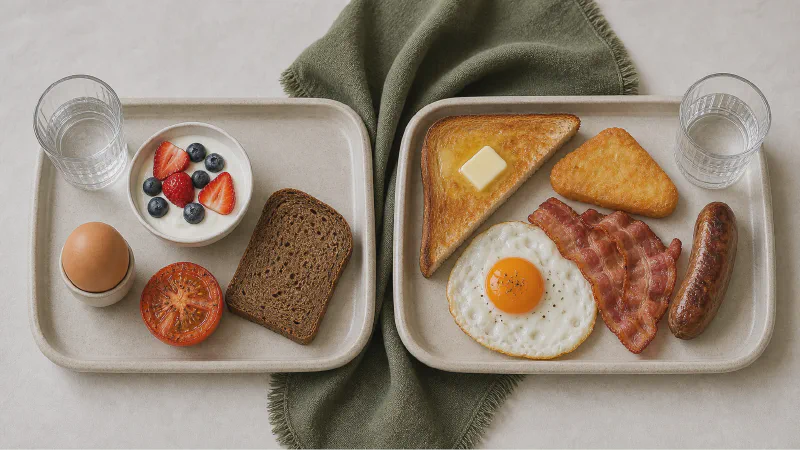
Same 350 g portion, different choices: eggs, protein, side, cold cut, bread and pastry, dairy bowl.
How buffet choices change hotel breakfast calories
In these two examples, the changes are: eggs — boiled egg → fried egg, protein — added: bacon, protein — added: sausage, side — grilled tomato → hash browns, bread and pastry — rye → toast, bread and pastry — added: butter.
Lower calorie
383 kcal
350 g
109 kcal per 100 g
higher vs lower calorie
+141%
Higher calorie
922 kcal
350 g
263 kcal per 100 g
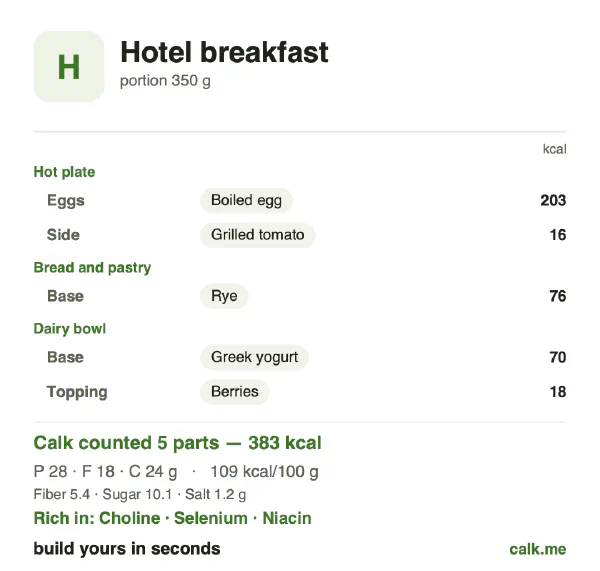
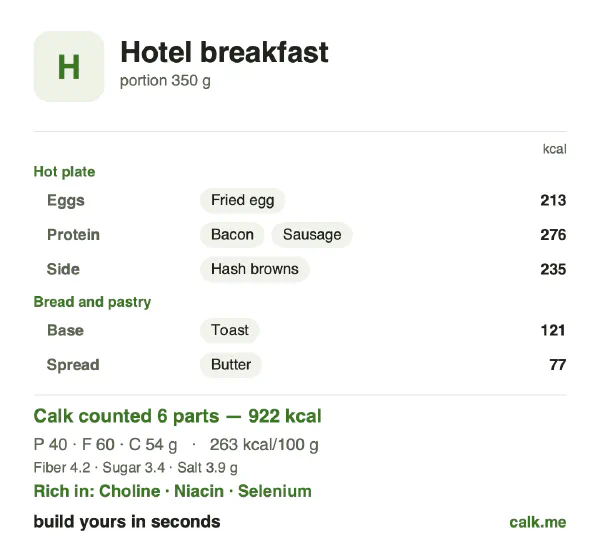
- One tray has a boiled egg and grilled tomato. The other has a fried egg, bacon, sausage and hash browns.
- The bacon, sausage, egg and hash browns on one tray are all fried.
- The other tray keeps the hot side simple with a boiled egg and grilled tomato.
- Yogurt with berries and rye bread complete that breakfast without the fried sides.
Continental, American and full English breakfast calories
Calculate calories and macros for a continental, American, English, Mediterranean or Scandinavian breakfast, including eggs, bread and drinks.
Hotel breakfastAmerican breakfastContinental breakfastFull English breakfastBagel and loxMediterranean breakfastScandinavian breakfastSweet pastry
More calorie comparisons for hotel breakfasts
Learn more
Questions about calories in hotel breakfasts
How do you count calories from a hotel breakfast buffet?
The two versions shown in Calk contain 383 and 922 kcal per 350 g. At a hotel buffet, fried breakfast foods, pastries and repeat servings can change the meal quickly.
Why is a fried English-style breakfast higher in calories than a lighter continental plate?
One tray has a boiled egg and grilled tomato. The other has a fried egg, bacon, sausage and hash browns. The bacon, sausage, egg and hash browns on one tray are all fried.
How do I calculate the hotel breakfast I ate?
Open Hotel breakfast in Calk and add the eggs, cooking fat, bacon or sausage, bread, pastry, fruit, spreads and drinks from every serving.
Calculate your own hotel breakfast in Calk
Calk is available on iPhone, iPad, and Android.