- Calk — the calorie counter you don't have to live in/
- Calories in everyday food/
- How many calories are in a cod fillet?/
Same-portion calorie comparison
How many calories are in a cod fillet?
A lean fillet stays relatively light until batter absorbs frying oil and a rich sauce or fries join the plate. Record preparation and sides in Calk.

Same 250 g portion, different choices: type of fish, coating, stuffing, sauce, cooking method.
How batter, frying and sauce change fish calories
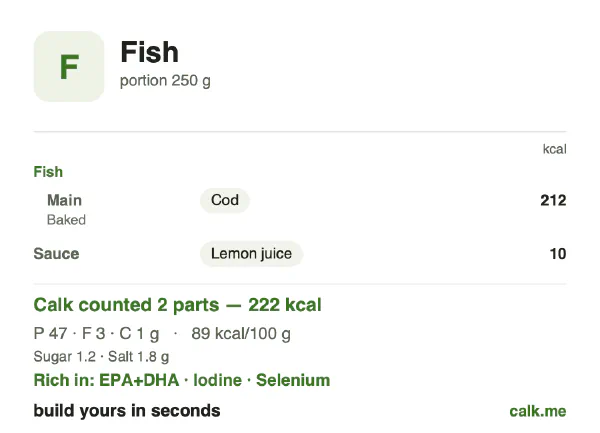
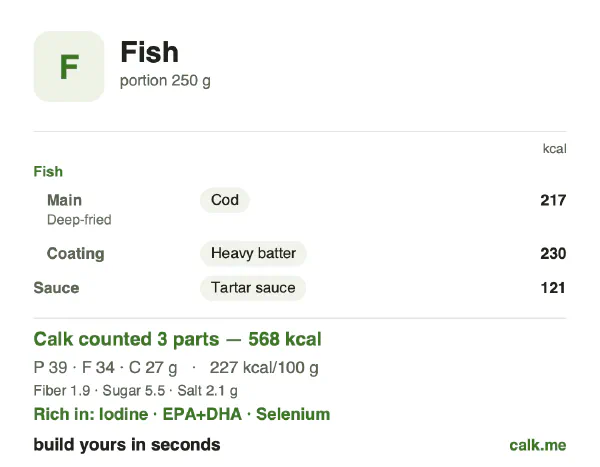
In these two examples, the changes are: coating — added: heavy batter, sauce — lemon juice → tartar sauce, cooking method — baked → deep-fried.
Lower calorie
222 kcal
250 g
89 kcal per 100 g
higher vs lower calorie
+156%
Higher calorie
568 kcal
250 g
227 kcal per 100 g
- Plain baked cod is roughly 105 kcal per 100 g, with most of its energy coming from protein.
- Heavy batter adds flour and retains frying oil, bringing the fish and chips to roughly 198 kcal per 100 g.
- A mayonnaise-based tartar sauce adds substantially more energy than lemon juice.
Steamed, baked, grilled and battered fish calories
Calculate calories and macros for steamed cod, baked white fish, grilled salmon or trout, battered fish and fish and chips.
FishSteamed white fishFish steakSteamed fishSteamed codFish and chipsFish in batterFish in flourPan-seared fishPan-fried fishGrilled hammour fishBaked fish
More calorie comparisons for fish dishes
Learn more
Questions about calories in fish dishes
How many calories are in baked cod compared with battered fried fish?
The two versions shown in Calk contain 222 and 568 kcal per 250 g. A lean fillet stays relatively light until batter absorbs frying oil and a rich sauce or fries join the plate.
Why is battered fish with mayonnaise higher in calories than plain baked cod?
Plain baked cod is roughly 105 kcal per 100 g, with most of its energy coming from protein. Heavy batter adds flour and retains frying oil, bringing the fish and chips to roughly 198 kcal per 100 g.
How do I calculate my own fish plate?
Open Fish in Calk and choose the species, cut, batter or coating, cooking method, sauce and side, then enter the portion you ate.
Calculate your own fish plate in Calk
Calk is available on iPhone, iPad, and Android.