
- Calk — the calorie counter you don't have to live in/
- Calories in everyday food/
- How many calories are in canned tuna?/
Same-portion calorie comparison
How many calories are in canned tuna?
The fish may be the same while an oil packing adds fat to every bite. Record the preserve type and whether you drained it in Calk.

Same 120 g portion, different choices: type of fish, packing liquid or oil, salt.
How the packing liquid changes canned fish calories
In these two examples, the changes are: packing liquid or oil — added: in oil (not drained).
Lower calorie
125 kcal
120 g
104 kcal per 100 g
higher vs lower calorie
+57%
Higher calorie
196 kcal
120 g
163 kcal per 100 g
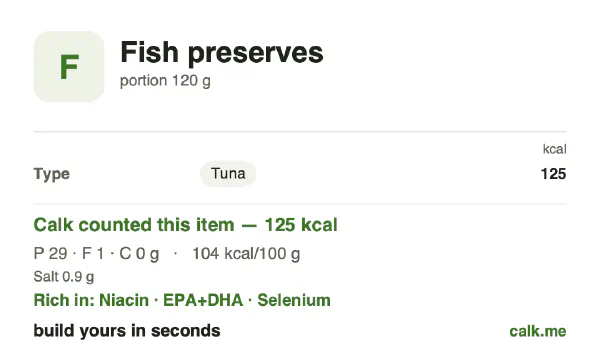
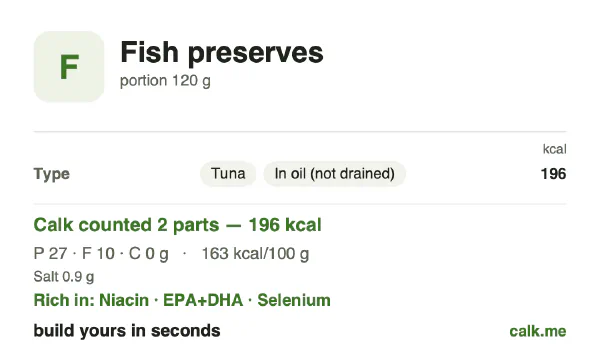
- Tuna in its own juice is mostly protein, at roughly 111 kcal per 100 g.
- Packed in oil, the same tuna reaches roughly 192 kcal per 100 g because it carries added fat.
- The protein is similar on both sides. The fat that comes with it changes the result.
Tuna, sardine, sprat and cod-liver preserve calories
Calculate calories and macros for tuna in water or oil, sardines, sprats, cod liver, canned fish in tomato and fish pâté.
Fish preservesFish pate (14% fat)Kilka in tomatoSprats in oilSardines in oilCanned fishCanned tunaCod liverPink salmonIwashiAnchoviesKilka
More calorie comparisons for canned fish
Learn more
Questions about calories in canned fish
Does tuna in oil have more calories than tuna in water?
The two versions shown in Calk contain 125 and 196 kcal per 120 g. The fish may be the same while an oil packing adds fat to every bite.
Why is oil-packed tuna higher in calories than tuna in its own juice?
Tuna in its own juice is mostly protein, at roughly 111 kcal per 100 g. Packed in oil, the same tuna reaches roughly 192 kcal per 100 g because it carries added fat.
How do I calculate the canned fish I ate?
Open Fish preserves in Calk and choose the fish and packing liquid, note whether oil was drained, then enter the edible serving weight.
Calculate your own canned-fish serving in Calk
Calk is available on iPhone, iPad, and Android.