
- Calk — the calorie counter you don't have to live in/
- Calories in everyday food/
- How many calories are in a layered dessert?/
Same-portion calorie comparison
How many calories are in a layered dessert?
At the same volume, mascarpone, whipped cream, cookie crumbs, chocolate sauce and nut spread add more fat and sugar than a berry yogurt base. Log every layer in Calk.

Same 150 g portion, different choices: layers, toppings, sauces and sweeteners, dessert base.
What makes a layered dessert more calorie-dense
In these two examples, the changes are: layers — sour cream 10% → cream, toppings — added: cookie crumbs, toppings — added: chocolate, sauces and sweeteners — berry puree → chocolate sauce, dessert base — yogurt → chocolate mousse, dessert base — added: mascarpone cream.
Lower calorie
111 kcal
150 g
74 kcal per 100 g
higher vs lower calorie
+368%
Higher calorie
519 kcal
150 g
346 kcal per 100 g
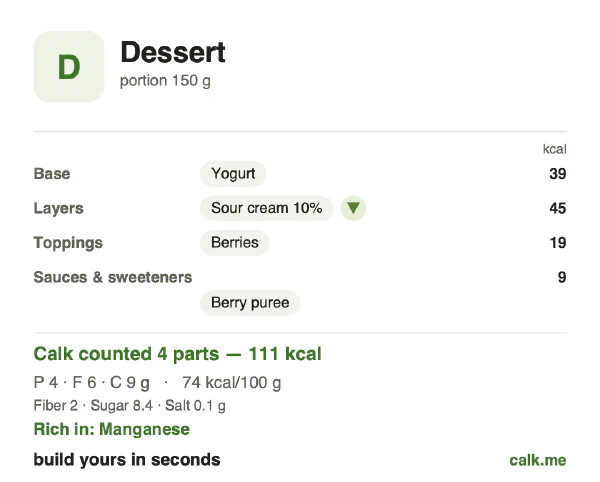
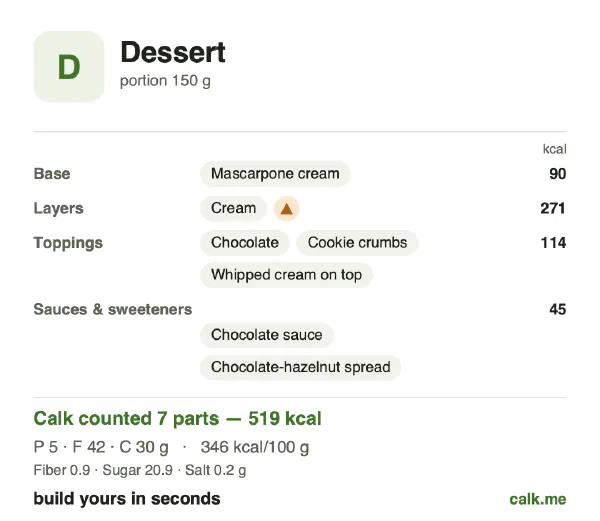
- A yogurt cup with light cream, berries and berry puree carries a lot of water and protein for the same 150 g serving.
- The other cup combines chocolate mousse, mascarpone, whipped cream, cookie crumbs, chocolate sauce and nut spread.
- Most of the difference comes from that creamy base and the calorie-dense additions, not the visible garnish.
Mousse, pudding, panna cotta and layered dessert calories
Calculate calories and macros for berry mousse, chocolate mousse, rice pudding, panna cotta, sticky toffee pudding or a layered dessert cup.
DessertTvorog dessertNo-bake cheesecakeRice puddingSmoothie bowlBerry mousse cupCoconut panna cottaRed berry puddingSticky toffee puddingChia puddingChocolate mousseChocolate pudding
More calorie comparisons for layered desserts
Learn more
Questions about calories in layered desserts
How many calories are in a berry yogurt dessert versus a chocolate dessert cup?
The two versions shown in Calk contain 111 and 519 kcal per 150 g. At the same volume, mascarpone, whipped cream, cookie crumbs, chocolate sauce and nut spread add more fat and sugar than a berry yogurt base.
Why is the mascarpone-and-chocolate dessert higher in calories than the berry yogurt version?
A yogurt cup with light cream, berries and berry puree carries a lot of water and protein for the same 150 g serving. The other cup combines chocolate mousse, mascarpone, whipped cream, cookie crumbs, chocolate sauce and nut spread.
How do I calculate my own layered dessert?
Open Dessert in Calk and add the base, cream, sponge or cookie layer, sauce, nut spread and toppings, then enter the serving weight.
Calculate your own layered dessert in Calk
Calk is available on iPhone, iPad, and Android.