- Calk — the calorie counter you don't have to live in/
- Calories in everyday food/
- How many calories are in one candy or a small handful?/
Same-portion calorie comparison
How many calories are in one candy or a small handful?
Estimate candy by pieces or a small handful, then distinguish sugar-based jelly from nut, praline and chocolate fillings.

Candy calorie calculator by type and pieces
Your estimate
Soft caramel
Standard
12 g
Calories50 kcal
Protein0.3 g
Fat1.4 g
Carbs8.9 g
Why candy fillings change calorie density
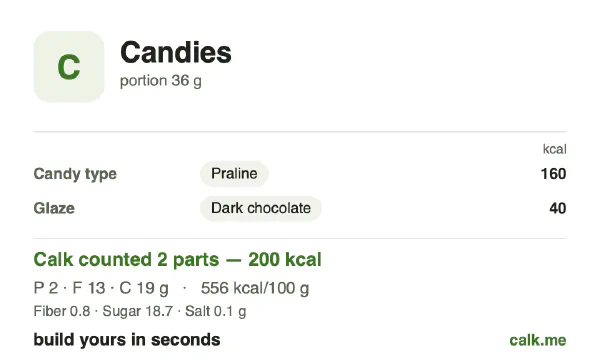
In these two examples, the changes are: candy type — fruit jelly → praline, glaze — sugar glaze → dark chocolate.
Lower calorie
112 kcal
36 g
311 kcal per 100 g
higher vs lower calorie
+79%
Higher calorie
200 kcal
36 g
556 kcal per 100 g
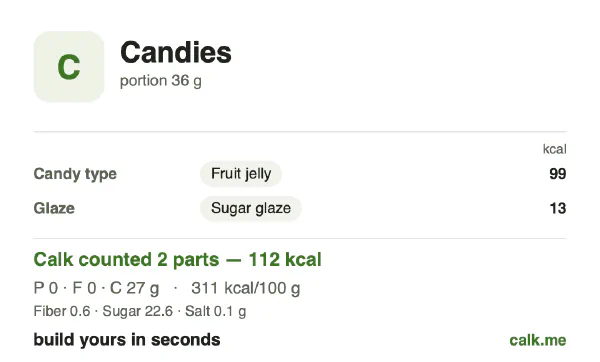
- Fruit jelly is made largely from pectin and sugar and contains almost no fat.
- Praline contains ground nuts and cocoa butter. That added fat raises the total from 339 to 543 kcal per 100 g.
- The coatings also differ: a thin sugar glaze versus dark chocolate.
- Both examples contain three candies. The selected type, not the serving count, changes the total.
Calories in jelly, chewy, praline and chocolate candy
Candy pieces vary in size, so the table pairs each count with an estimated gram weight for a more useful comparison.
| Type | Portion | Calories |
|---|---|---|
| Sugar-free jelly | Standard ≈ 12 g | 26 kcal |
| Dried fruit candy | Standard ≈ 12 g | 40 kcal |
| Fruit jelly | Standard ≈ 12 g | 37 kcal |
| Marshmallow | Standard ≈ 12 g | 40 kcal |
| Liqueur candy | Standard ≈ 12 g | 46 kcal |
| Gummy bears | Standard ≈ 12 g | 41 kcal |
| Soft caramel | Standard ≈ 12 g | 50 kcal |
| Hard candy | Standard ≈ 12 g | 47 kcal |
| Chewy candy | Standard ≈ 12 g | 47 kcal |
| Coated chewy candy | Standard ≈ 12 g | 48 kcal |
| Fudge | Standard ≈ 12 g | 53 kcal |
| Souffle candy | Standard ≈ 12 g | 55 kcal |
| Toffee | Standard ≈ 12 g | 50 kcal |
| Praline | Standard ≈ 12 g | 67 kcal |
| Turkish delight | Standard piece ≈ 22 g | 71 kcal |
| Churchkhela | Standard piece ≈ 22 g | 91 kcal |
| Turkish delight with nuts | Standard piece ≈ 22 g | 78 kcal |
| Nougat | Standard piece ≈ 22 g | 95 kcal |
| Marzipan | Standard piece ≈ 22 g | 95 kcal |
| Kozinaki | Standard piece ≈ 22 g | 102 kcal |
| Halva | Standard piece ≈ 22 g | 120 kcal |
Candy bowls, mixed sweets and filled pieces
Use Calk to calculate calories and macros for fruit jelly, chewy candy, Turkish delight, praline, dried-fruit candy and mixed sweets.
CandiesTurkish delight with nutsOriental & Arabic sweetsDried fruit candyFruit jelly candyChewy candyFruit jellyGummy bearsHard candySoft caramelSouffle candyTurkish delight
More candy and sweet comparisons
Learn more
Questions about candy portions
How do I estimate calories in a few pieces of candy?
Choose the candy and piece count above. The two shown 36 g servings contain 112 and 200 kcal, but individual candy weights vary.
Why is nut praline more calorie-dense than fruit jelly candy?
Fruit jelly is made largely from pectin and sugar and contains almost no fat. Praline contains ground nuts and cocoa butter. That added fat raises the total from 339 to 543 kcal per 100 g.
How do I count a mixed candy bowl?
Calculate the main candy types above, then open Candies in Calk and add each different piece or its share of the total weight.
Calculate your candy serving in Calk
Calk is available on iPhone, iPad, and Android.