
“You don’t need to count calories” is the most profitable claim in nutrition blogging. It relieves the reader of boring work, it promises freedom, and — more important to the author — it leaves room for a paid method: a list of rules, an eating window, a set of foods, a subscription to a plan.
The claim is also nearly true. That is exactly what makes it so durable.
All of these methods count for you#
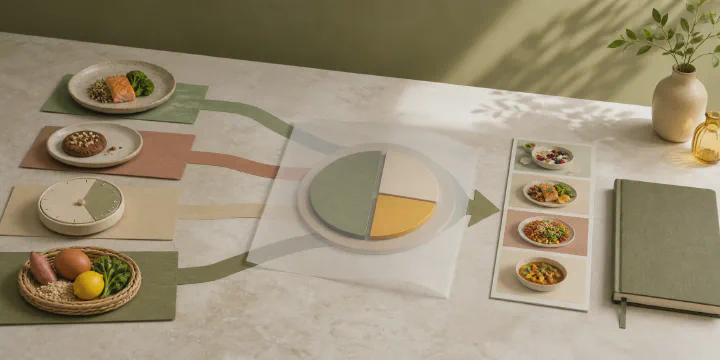
Cutting sweets, “whole foods only”, intermittent fasting, the quartered plate, going gluten-free, no dinner after seven — they work precisely to the extent that they reduce incoming energy. Remove sugar and the drinks and desserts go with it. Shift the eating window and the evening snack disappears. Swap refined for whole and the same plate becomes bulkier and more filling at fewer calories.
None of these methods repeals the arithmetic. They hide it: the rule creates a deficit blind, and you see neither its size nor the moment it stopped working.
While weight is going down, the difference is invisible. It shows up when weight stops — and the method cannot say why. A rule does not know that the portion of nuts has doubled, that there is syrup in the coffee now, or that the “healthy” sauce runs 180 kcal a serving. Where calories usually hide is a separate article, and almost every example in it passes any list of “approved foods”.
People underreport their own eating — even when they write it down#
This is the least comfortable part of the conversation, and it has been measured many times.
Participants who were not losing weight “despite eating very little” underreported what they ate by about 47% on average and overreported their physical activity by about 51% Lichtman 1992. In a controlled comparison of week-long food records, qualified dietitians came in 223 kcal a day below their measured expenditure, about 10%; women without that training came in 429 kcal below, almost 19% Champagne 2002. In a large biomarker study, underreporting ran 12–20% when people were interviewed in detail about the day before and 31–38% on questionnaires about usual eating Subar 2003.
Note who is getting it wrong. Not only beginners: the dietitians’ own records also landed under their measured expenditure — twice as close as everyone else’s, but still under. Training shrinks the error; it does not remove it.
These are group results and should be read as group results: the average shift points downward, but an individual’s error can be small or run the other way. What follows is not “you are lying” but “your own estimate is not a known quantity until you have checked it”.
From which follows what the blogs usually leave out. “I eat clean and I’m not losing weight” does have medical explanations — the thyroid, medication, a range of conditions. A doctor checks those, not an app, and the diary settles nothing there: if symptoms have appeared, if how you feel has changed, or if medication changed recently, go regardless of what the records would show.
The diary checks something else, alongside: one very common everyday cause — the gap between how much you eat and how much you think you eat. Its advantage is that you can check it yourself, and for free.
What is actually known about counting#
Food records do not help by their mere existence. They make changes in eating visible.
Logging food more often is consistently associated with greater weight loss inside weight-loss programs.1 But that is an observed association within programs, not proof that the diary itself moves weight: people who log more often are usually more engaged in everything else. The honest version sounds more modest and is still strong enough: counting is the most direct way to see what every other method does blind.
It also has a measured weakness. In two 24-week programs, week nine was the last week when at least half the participants logged anything at all on a given day.2 Daily logging quickly became uncommon in those programs.
That does not make counting useless. It shows the cost of a format that asks for the same work for 24 weeks. Useful data can arrive earlier, so an open-ended diary is a poor shape for a working method.
What to do about it#
If counting yields information no rule can give, and its problem is that it never ends, the answer is obvious: use the information to change familiar meals, then finish daily logging once those changes are habits.
Log everything, forever. In the two programs studied, week nine was the last week in which at least half the participants logged anything at all on a given day.
A month of ordinary food shows what to change. Try the changes in familiar meals; once they are habits, daily logging ends.
The order Calk is built for:
- Log ordinary food for a month. Not a model week: weekdays, weekends, delivery, dinner in a café.
- Look at what your diet rests on. Which meals repeat, what supplies most of the calories, where the protein and fiber come from, which food groups never appear. Food observations appear as the diary fills up, and the monthly Nutrition Report puts the whole month together.
- Change one or two familiar meals. Not the whole diet — the ones pulling the result. Calorie density has the most direct evidence: when it was cut by a quarter across all the food served, 24 young women ate 575 kcal a day less, with no significant difference in hunger or fullness ratings Rolls 2006. In a familiar meal that means changing what the dish is made of rather than adding food on top, since the addition brings its own calories. The longer-term evidence, and the separate findings on protein and fiber, are in why diets don’t work.
- Once every chosen change is a habit and your weight trend is on track, end daily food logging and keep weighing yourself.
- Come back for a reason, not on a schedule: the trend moved, the routine changed, the season turned.
Calk has no streaks, no red days and no reminders to close the day — precisely because the method is supposed to end rather than turn into a lifelong obligation.
The precision you need is not the precision you imagine#
One more objection to counting: “you have to weigh every gram, it’s unbearable.” For the job described above, you do not.
The difference between “about 640 kcal” and “about 690 kcal” changes nothing in the decision you are counting for. The difference between “I eat about 1,800” and “actually 2,600” changes everything, and it is visible without any scale. That is what a meal template is for: you open a familiar shape and mark what the dish actually has — the protein, the preparation, the fat, the sauce, the portion. Half a minute. The method is worked through in counting calories without kitchen scales, and Calk measures and publishes its own error.
A diary you abandoned on day five because of the scale does not become more accurate.
When “don’t count” is the right answer#
There are cases where not counting is the right call.
- It harms you. If logging intensifies fear of food, guilt, rigid restriction, compulsive calculation or urges to compensate for eating — stop, and seek qualified support. No result is worth that.
- The question is already closed. If you have taken your diet apart and your weight is holding, there is nothing to count: that is what a weight trend and short returns are for.
- The rule suits you. If a simple restriction genuinely works and weight is going where it should — it is already creating the deficit. Counting becomes useful when the movement stops.
Why an open-ended diary falls apart on its own is covered in why calorie counters fail. What to do if you are already tired and afraid to start again is in calorie-tracking fatigue.
In short#
You can lose weight without counting calories. You cannot get around an energy deficit.
Every “no counting” method counts for you; it just does not show the result. While that works, everything is fine. When it stops, you have no data to explain why — and your own estimate, it turns out, sits below what you actually ate, professionals included.
Start with a month of ordinary food, approximate but honest. Keep recording as you change your familiar meals; stop when those changes are habits.
If a diet was only a list of restrictions, it leaves no landmarks when the restrictions end. The old meals and servings come back, and the old energy balance with them. So the check should leave you with something: which familiar meals drive the result, and what to change inside them.
Calk shows repeating meals, sources of calories and nutrients, and possible changes within familiar food. The diary does not then need to continue for its own sake: the changes stay in ordinary life, while the weight trend shows the direction.
Calk is available on iPhone, iPad, and Android.



Frequently asked questions#
Can you lose weight without counting calories?
How accurately do people estimate their own eating by eye?
Is it true that counting calories helps you lose weight?
Why do so many people quit counting, then?
Who should not count?
Sources and limitations#
The underreporting studies used different samples and different methods; the specific percentages do not transfer to an individual and are given as an order of magnitude, not as your personal error. The study behind the 47% selected its participants on their complaint of not losing weight; the dietitian comparison ran on twenty women, and for the trained group the gap from measured expenditure was within statistical noise. The association between logging frequency and weight loss was observed inside weight-loss programs and does not establish causation.
Harvey J. et al. Log Often, Lose More: Electronic Dietary Self-Monitoring for Weight Loss. Obesity, 2019. An observed association between logging frequency and weight loss inside an online weight-loss program. ↩︎
Turner-McGrievy G. M. et al. Defining Adherence to Mobile Dietary Self-Monitoring and Assessing Tracking Over Time. Journal of the Academy of Nutrition and Dietetics, 2019; secondary analysis of two 24-week randomized trials, n=124. ↩︎