
A scale measures your total mass at one moment. It cannot tell how much of a change since yesterday came from body fat, water, glycogen or food still being digested.
The number is real. “I ruined it yesterday” is your reading of it. To see whether weight is rising, falling or staying stable, compare repeated measurements taken under similar conditions.
What can change between two weigh-ins#
Several things can change the reading:
| What changed | How it affects the reading |
|---|---|
| Water | Fluid intake, sweating, sodium and normal fluid regulation can move the number. |
| Glycogen | Stored carbohydrate is held with water, so changes in carbohydrate intake and use also change water weight. |
| Food and drink | Material still in the digestive tract has mass. |
| Measurement conditions | Time of day, clothing, the scale and its position can make readings less comparable. |
| Body tissue | Changes in fat and lean tissue contribute to weight, but the scale cannot separate them. |
In a study of 46 adults living normally, most of the body-weight change measured across two weeks was attributed to fat-free mass, which includes body water—not body fat Bhutani 2017. This is why converting every short-term change into an equivalent amount of body fat gives a false sense of precision.
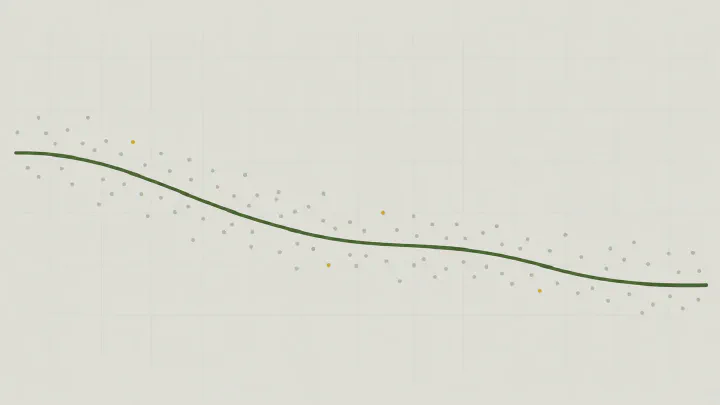
One person, six weeks
Illustrative: individual readings move around the smoothed direction.
Make the measurements comparable#
Keep measurement conditions reasonably consistent.
- Use the same scale on a hard, level surface.
- Weigh at a similar point in your routine—for example, after waking and using the bathroom, before eating or drinking.
- Use several readings rather than choosing the highest or lowest one.
- Treat travel, illness, a very salty meal and an unusual training session as context, not as an instant explanation for fat gain or loss.
How often you weigh is a personal choice. In a cohort of 10,000 smart-scale users, more frequent self-weighing was associated with better weight outcomes, but the observational study cannot prove that weighing caused the difference Vuorinen 2021. If weighing causes distress or is unsuitable for a medical reason, it should not be your main monitoring method.
What Calk does with the readings#
Calk keeps the individual measurements and draws a smoothed line through them. The dots show what the scale reported; the line makes the direction easier to see.
The line answers a narrow, useful question: is body weight moving toward your goal, away from it or staying around the same level? Calk uses that direction instead of treating one morning as success or failure.
You can see the same logic in the weight and calories report guide.
When a flat trend deserves a closer look#
Two similar weigh-ins do not establish a plateau. Collect enough comparable measurements to see whether the smoothed line stays flat over time. If your goal is to maintain your weight, a flat trend is a good result.
If your goal is weight loss or gain, check a few things before changing the whole plan:
- Were the weigh-ins taken under similar conditions?
- Has the food routine changed in a way your previous estimate no longer captures?
- Has activity, sleep, medication or health changed?
- Does the current calorie target still match your current body weight and goal?
Calk helps you compare the records: the trend shows the change, and a short food check helps you look for its source. The app does not diagnose medical causes. Discuss rapid unexplained changes, swelling or other symptoms with a healthcare professional.
When you can stop logging food#
Review your usual diet and make the changes you need, then follow your weight. Once each change is part of your routine and the trend is on track, you can stop logging food every day and keep weighing yourself. Return to the diary if your weight persistently moves away from your goal or your routine changes.
A weigh-in gives you a number. The trend helps you decide when to act.