
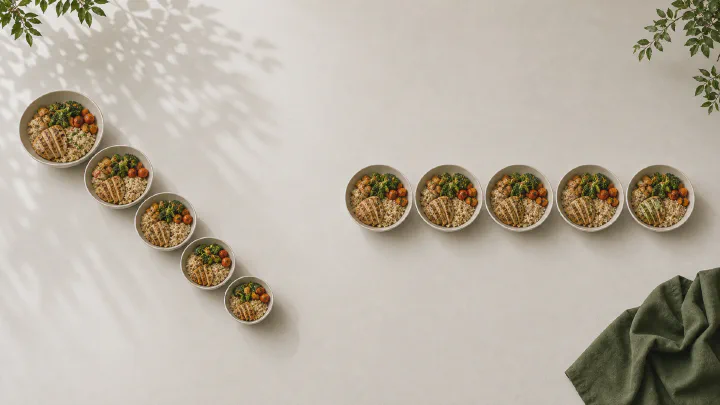
For intentional weight gain, use the weight trend to check direction, add food through meals you can repeat and run a short food check when the result does not match the plan. Training and protein matter when muscle gain is the goal; clinical recovery needs its own professional target.
Start with your usual diet, choose a few easy additions and check the result on the scale. Once those additions are habits and the trend is on track, you can put daily food logging aside until your next review.
Use the trend to judge weight gain#
Intentional weight gain depends on a sustained pattern of eating, rather than one large meal.
That is why the first mistake is reacting to yesterday. One large dinner, one salty restaurant meal, or one hard training session can move the scale for reasons that have little to do with new tissue. Look at the smoothed line over a few weeks, exactly as in understanding your weight trend.
For weight gain, the question is simple:
| Trend | Meaning | Useful response |
|---|---|---|
| Flat across a sustained run of comparable measurements | Intake may be near maintenance | Review intake, then add a small repeatable portion if needed |
| Rising slowly | The surplus is probably enough | Keep the pattern steady |
| Rising fast | The surplus may be larger than needed | Reduce one calorie-dense addition |
| Jumped in a few days | One change cannot separate tissue from water, glycogen or gut contents | Keep the plan steady and keep measuring |
The trend helps you avoid adding food just because the scale has stayed put for a few days, or cutting back after a brief jump in water weight.
Start with a baseline week#
Before you add food, learn what you already eat.
Log a normal week: training days, rest days, the meals you actually repeat, the snacks that happen because they are convenient. Keep eating as you normally do. The baseline should answer three questions:
- What does your current maintenance intake roughly look like?
- Which meals are easiest to expand?
- Where is protein already strong, and where is it thin?
Use those answers to choose changes to familiar meals. Make the changes and follow your weight. Once all the changes are habits and the trend is on track, you can stop logging food every day and keep weighing yourself. Return to the diary if your weight persistently moves away from your goal or your routine changes.
Add food to familiar meals#
A few repeatable additions to familiar meals can help you increase intake consistently.
Start here:
- Add a second fist of rice, pasta, oats, potatoes, or bread to a meal where it fits.
- Add olive oil, avocado, nuts, tahini, cheese, or yogurt where it fits.
- Add milk, yogurt, or a smoothie around training if solid food is hard to increase.
- Choose a regular breakfast: eggs plus toast, oats plus yogurt, or a sandwich.
- Add one planned snack instead of grazing through whatever is nearby.
Repetition is the point. A gradual gain does not need one huge dinner; it needs a plate you will actually repeat on an ordinary Tuesday.
In a Calk template, you can adjust your usual meal and save your version to favorites with the ♥ button. Increase the rice portion, add tahini or choose a larger serving; the rest of the bowl stays the same. See what a meal template is.
Check protein intake#
Protein matters when the goal includes muscle because resistance training supplies the stimulus and protein supplies amino acids. The adult reference intake used to prevent deficiency is not a body-composition target Rand 2003. A sports-nutrition position stand gives 1.4–2.0 g/kg per day as a general range for exercising people Jäger 2017. Individual needs and clinical limits can differ.
The practical version:
- Put a palm or two of protein in most meals.
- Spread protein across the day instead of saving almost all of it for dinner Mamerow 2014 Schoenfeld 2018.
- Run a short food check to see whether protein is adequate if the trend is rising but training is not improving.
Calk’s protein adequacy and protein in a meal insights review the recorded amount and whether main meals carry a real protein serving.
Lean bulk, recomp, and the maintenance line#
People use “weight gain” for different jobs.
If you are under your comfortable weight, the goal may be a steady return. If you are training, it may be a lean bulk. If you are recomping, the scale may barely move while strength, performance, or photos change.
Read the weight trend alongside your training and meals:
- Are lifts, training volume, or recovery improving?
- Are meals easier to repeat than they were two weeks ago?
- Is protein present in enough meals?
- Is the trend moving at the pace you intended?
The inverse article, slow weight loss, makes the same point from the other direction: speed matters because body composition is part of the goal.
When the trend does not rise#
If the smoothed trend stays flat across a run of comparable measurements, the first step is not to rebuild your entire diet. Find one repeated addition and make it consistent.
Common reasons a gain plan stalls:
- The added snack happens only on training days, not most days.
- The extra portion replaced something else without you noticing.
- Restaurant or weekend eating is high, but weekday meals are still too light.
- Training increased energy expenditure more than expected.
- The “large” portion is still smaller than you think.
Pick one repeated addition and keep it consistent long enough to see its effect in the trend. A bigger breakfast, an extra starch serving at dinner, or a planned snack is easier to evaluate than five scattered changes.
This is the upward version of the calorie range: the trend tells you when the current intake is outside the path you meant to follow.
What to track, and what to ignore#
Track your weight trend, total calories during short food checks, protein intake, the meal changes you are testing and training performance if body composition is the goal. There is no need to overhaul your diet over a single jump on the scale or a small difference in macro ratios. Once those meal changes are habits and produce the trend you want, you can stop logging food every day.
Calk supports that cycle: choose ingredients and a portion, save your usual version to favorites, read your food observations and the monthly Nutrition Report, add what they point to and check the result against your weight trend. Read how to maintain weight without daily tracking for the process, and how accurate Calk is for more on the food estimates.
Calk is available on iPhone, iPad, and Android.