
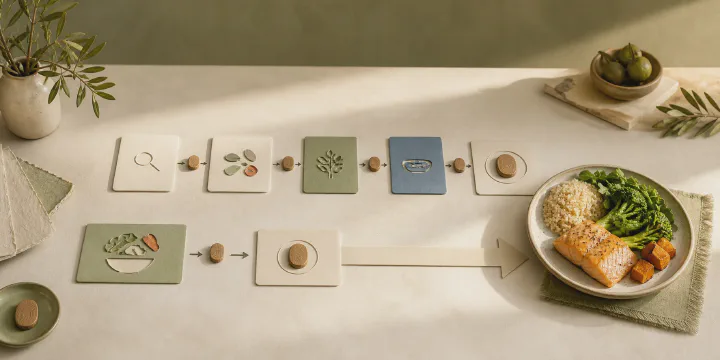
Almost every food diary begins with a search. Text searches by name. A barcode searches by package code. A photo logger searches by what its model thinks is on the plate; voice searches by the description you gave it. Even when there is no search box, the app is still retrieving or proposing a match.
That first result is not yet a finished entry. You still decide whether it found the right food, set the portion, and catch a missing sauce or a wrong ingredient. Logging speed is therefore the whole route to Save — plus whatever part of that route comes back tomorrow.
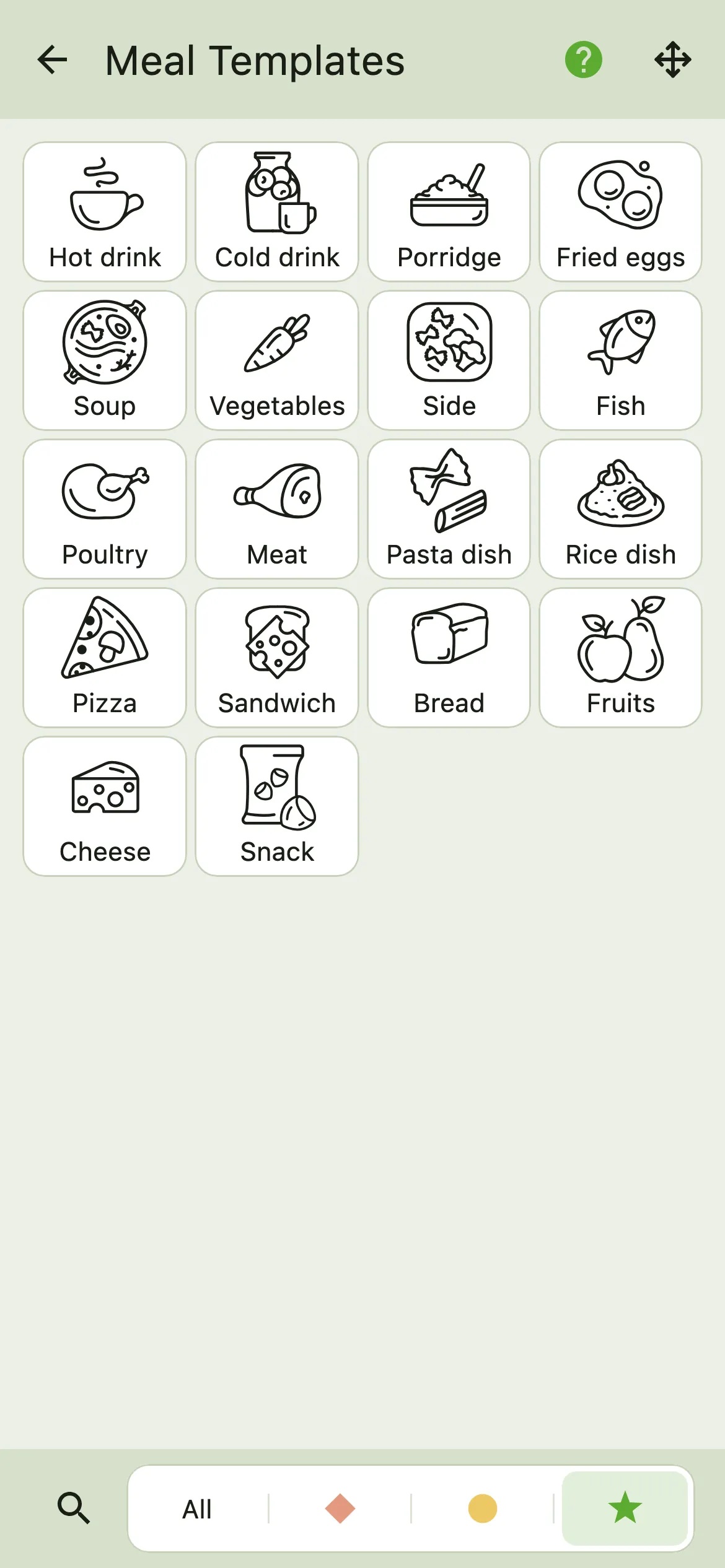
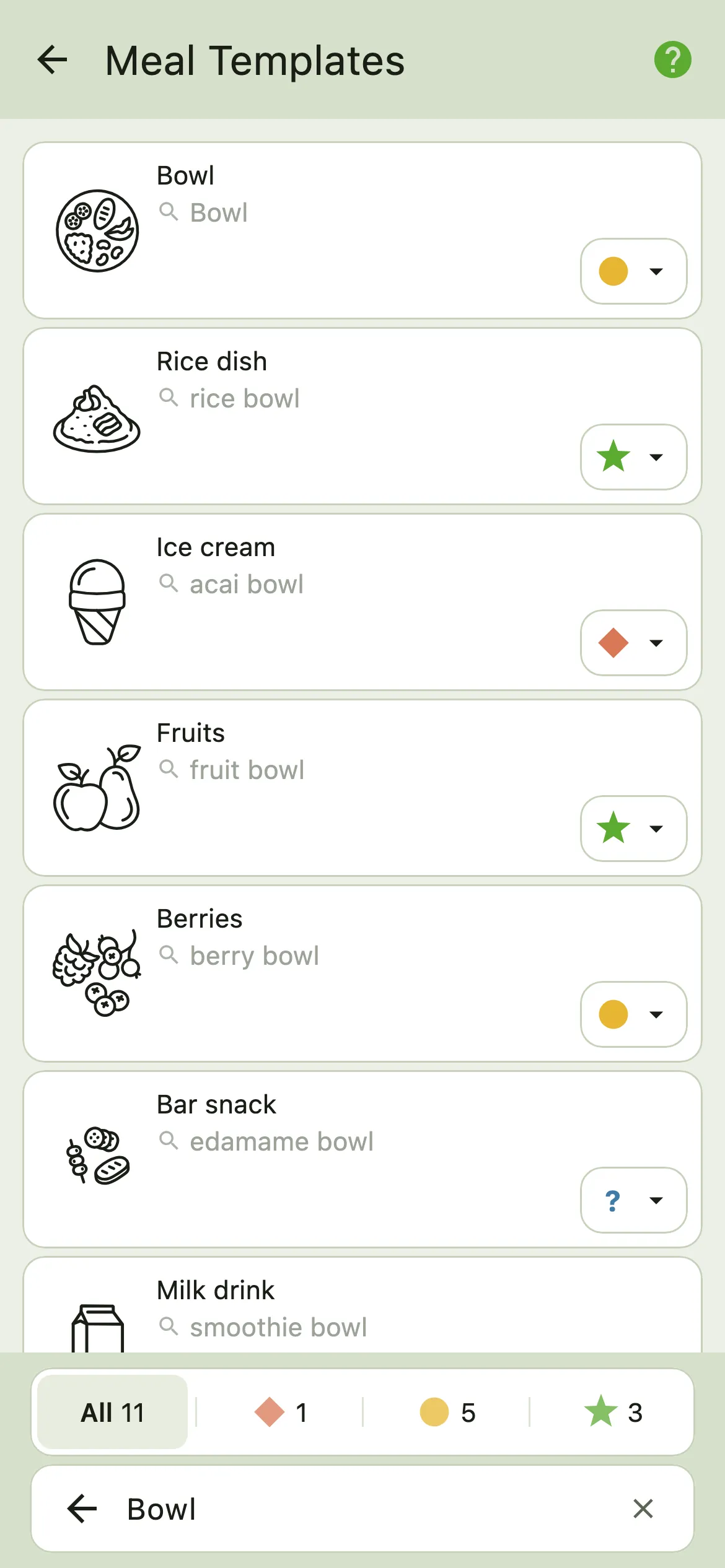
Calk searches for an editable dish template rather than a database row: Bowl, Green salad, Porridge. You find and shape it once. From then on it sits on your tab with its usual composition, so that dish never pays the search cost again.
 Open full size ↗
 Open full size ↗
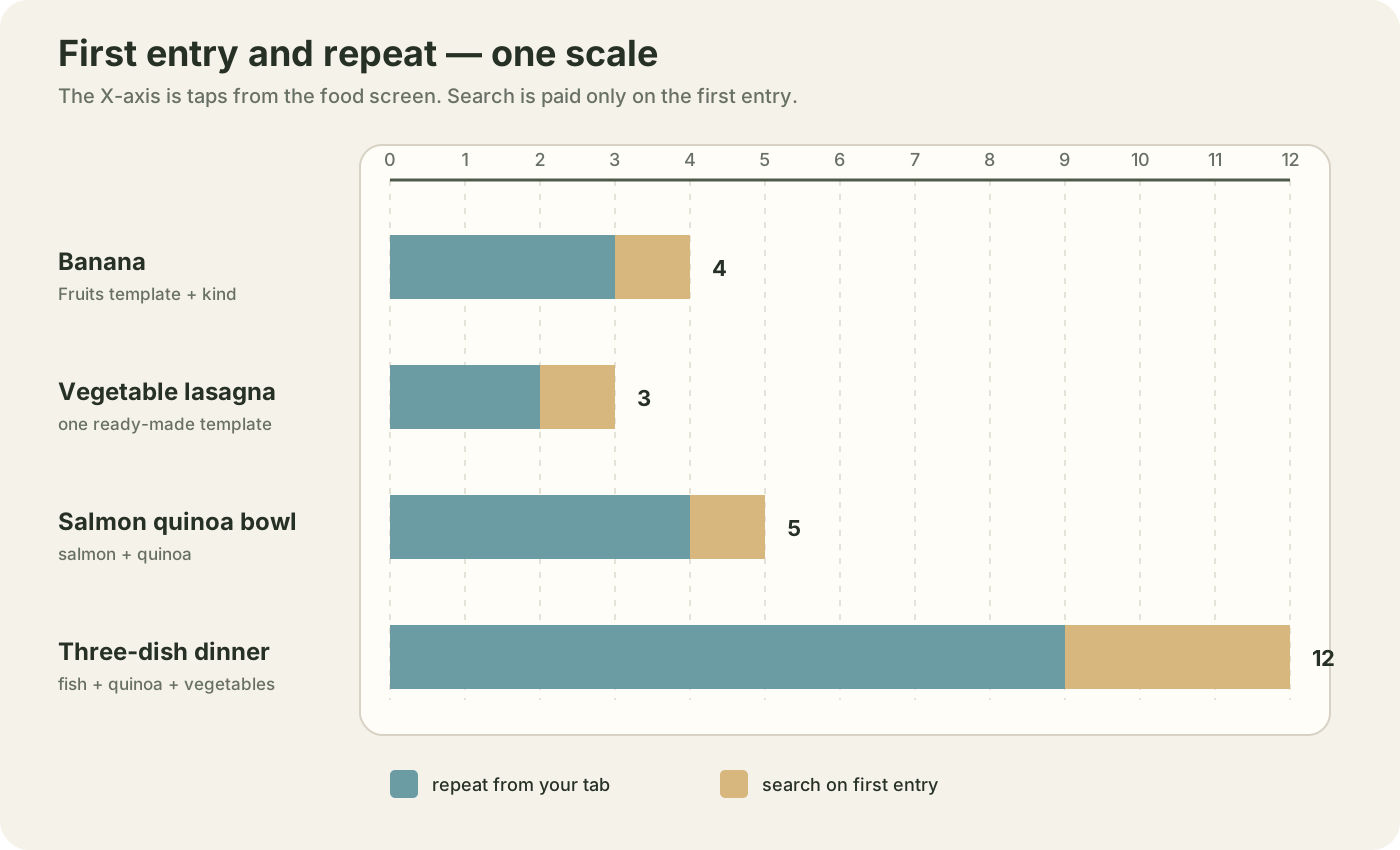
Visual complexity is not the same thing as tap count. Lasagna can be one ready-made template, while a banana needs the fruit type selected. Extra taps follow named differences from the template, not every ingredient on the plate.
 Open full size ↗
The first entry: find it and build it#
The base is three taps: open search, open the found template, tap Eat. The search field focuses itself, and typing is not counted as taps. Beyond those three, one tap is charged for each part the dish names, one for a question the template will not save without, and one for a portion said to be other than the usual.
| Dish | Template | Named beyond the template | Taps |
|---|---|---|---|
| Apple | Fruits | nothing | 3 |
| Scrambled eggs | Fried eggs | nothing | 3 |
| Steamed vegetables | Vegetables | nothing | 3 |
| Banana | Fruits | which fruit — banana | 4 |
| Steak | Meat | the cut — strip steak | 4 |
| Grilled salmon | Fish | salmon; grilled | 5 |
| Toast with tomato and ham | Sandwich | tomato; ham | 5 |
The Fruits card already describes an apple by default — so an apple is three taps. A banana is picked inside it — four.
Across the 13,543 corpus dishes, the first entry came out like this: 60.5% took exactly three taps, 83.8% took four or fewer, 3.63 on average.
Run of August 15, 2026, app version 1.0.7.
A found template gets dragged onto your own tab. From then on the search for that dish is never paid again: it is logged from the tab.
From then on — from your tab#
This is the price the diary lives at, day after day:
Every first-entry count includes exactly one tap on search, and from the tab that tap is gone. So the 60.5% of dishes that cost three taps to set up are logged from the tab in two, and 83.8% in three or fewer.
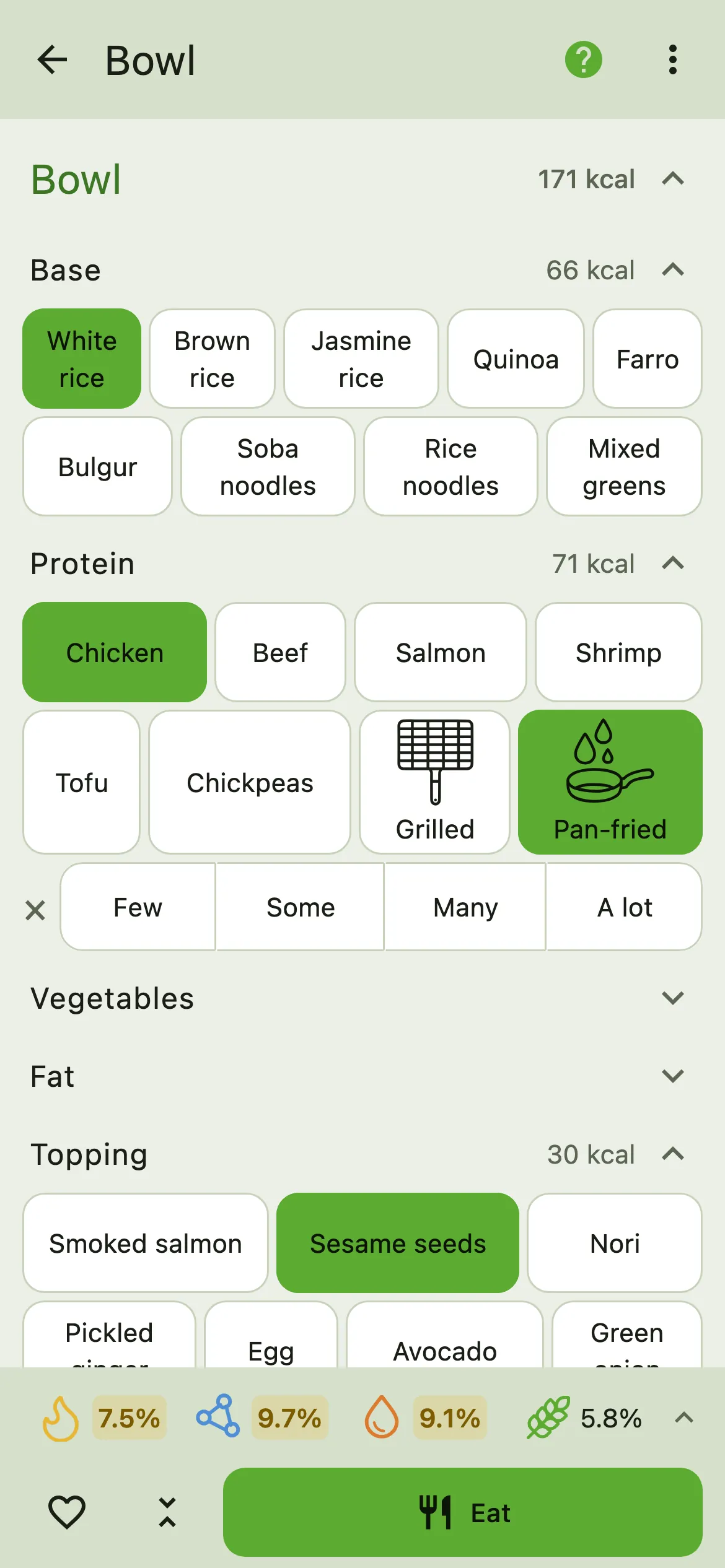
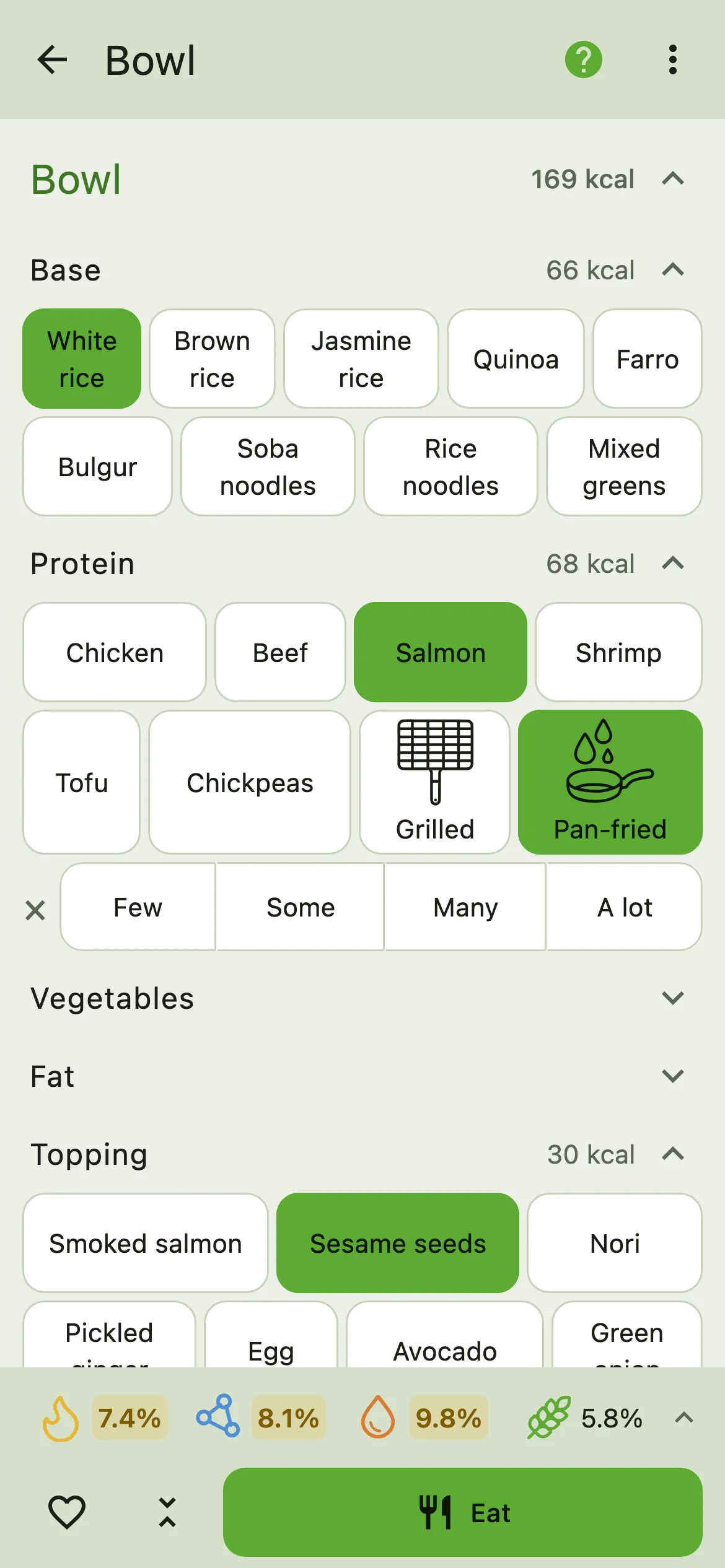
The template opens with the same protein, sauce and portion as last time. Changing one part is one tap:
 Open full size ↗
 Open full size ↗
How templates work — in how Calk’s meal templates work.
A meal is several dishes#
A single-dish meal is rare: 524 out of 5,183. An ordinary meal is two or three dishes, each with its own template.
One of the corpus’s most frequent three-dish dinners:
| Dish | Template | Taps |
|---|---|---|
| Salmon fillet | Fish | 4 |
| Quinoa | Side | 5 |
| Steamed vegetables | Vegetables | 3 |
| The whole dinner | three templates | 12 |
Quinoa costs a tap more than the fillet: the side card will not save until one more choice is made. From scratch that dinner is twelve taps; from your tabs, nine — three searches gone. Averaged over all 5,183 meals, a meal logged entirely from scratch costs 9.5 taps: breakfast 10.9, lunch 10.8, dinner 10.2, a snack 5.9 — a snack is usually one or two dishes.
It works the other way too: a complex dish can be one template. A full breakfast — the plate with eggs, bacon and toast at once — is a single Homemade breakfast template at three taps: the usual composition is already assembled inside.
How this was measured#
We wrote down what people eat for breakfast, lunch, dinner and in between in thirteen countries: the USA, Canada, the UK, Germany, France, Spain, Poland, Czechia, Russia, Israel, the UAE, Mexico and Brazil. The full corpus contains 13,561 dishes across 5,189 meals. Eighteen dishes name food that is not yet in the catalog and are set aside; that leaves the 13,543 dishes every figure here is counted on — 1,572 different names between them — and the 5,183 meals that still hold at least one of those dishes.
Every dish is replayed against the code of the shipping app — the same search and the same templates you have — and the taps it takes to log it as new, search included, are counted. Nobody’s food diary is opened for this. The count starts from the food screen; after a cold launch of the app any entry costs one tap more. The measurement is deterministic: the same corpus on the same catalog version gives the same numbers.
The measurement has three limits. Taps are not seconds: at one to two seconds a tap, plus the dish name typed at four characters a second — eleven characters on average — an ordinary entry comes to six to ten seconds, but that is a calculation, not a stopwatch, and deciding how big the portion was is not in it. These numbers do not compare with other apps’ speed indexes: another measurement counts other scenarios by another method. And it is no promise about your plate: a dish nobody wrote into the scenarios is in none of the figures above.
Where a dish has more than one valid reading, the model publishes both bounds: 3.63 taps on average under the cheaper reading and 3.68 under the dearer one. The lower estimate is not presented as the only possible interpretation.
The most expensive entry is the first one#
The diary costs the most in its first days, while dishes are being set up: three or four taps each, and one of those is a search that will never repeat for that dish.
And diets repeat: the corpus’s 13,543 entries carry 1,572 different names between them, so almost nine entries in ten name a dish that has already appeared. The familiar sits on a tab, an entry is two taps, a change is three. The diary gets cheaper by the day.
It also has an end. A month of ordinary meals shows what your diet is actually built around and what is worth changing. Keep logging as you try the changes; when they have all become habits, you can close the food diary and keep the smoothed weight trend running in the background, as long as weigh-ins keep arriving from a connected health service or are added by hand — enough to notice a drift and come back to check.
Where a design that remembers dishes sits among barcode search, photo AI and permanent diaries is laid out in the calorie tracker market map.
The first time, you find and shape the dish. After that, Calk remembers it for you.
Calk is available on iPhone, iPad, and Android.