
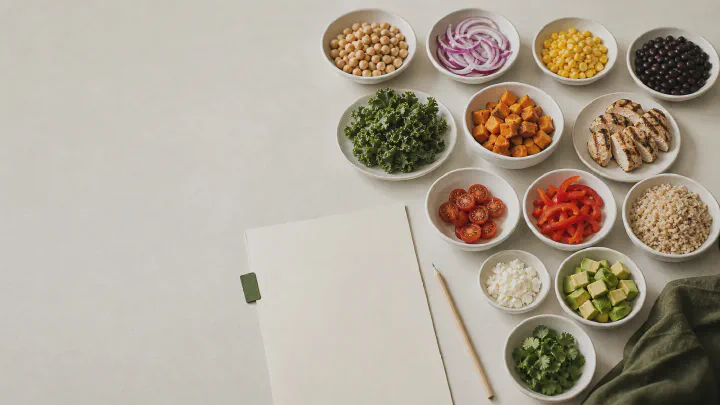
A large food database gives you many answers and leaves you to choose. Calk sorts those rows first, then gives you one starting point you can edit.
That small catalog is not built from one small source. Underneath it are national food tables, specialist datasets, scientific papers, packaged-food labels and recipe records — each used for a different purpose.
The three numbers count different things. The first includes cooking variations, not 2,100 unrelated ingredient names. The last is comparison material, not 10,000 recipes shown in the app.
Many sources. One clear food option#
Take baked salmon. A search database may show several species, branded products, restaurant dishes, user entries and cooking methods together. Calk needs one ordinary baked-salmon option — and separate options when raw, boiled, fried or another preparation materially changes the result.
That does not mean throwing every salmon-like row into an average. Salmon with pesto is a complete dish. Trout is another fish. Data for one specific salmon species may be useful, but it should not quietly change the number a user sees for ordinary baked salmon.
Compatible sources can still complete one another. One may have strong values for protein and fat, another may report iodine or fatty acids, and a suitable paper may cover a nutrient that national tables rarely measure. When one field is missing, Calk looks for another suitable source.
Salmon, baked — not trout, not salmon with pesto, not every species at once.
Use each compatible source for the nutrients it actually reports.
The meal template gets one clear option instead of a page of competing rows.
Calk selects and combines suitable sources. The result is a generic starting point: it removes avoidable ambiguity without claiming that every salmon fillet has the same composition.
Sources beyond USDA#
The current source list contains 40+ official food-composition datasets and scientific papers with checkable references. The best-known names include:
Different source types do different work:
| Source type | What Calk uses it for |
|---|---|
| National food tables | Basic ingredients, preparation states, calories, macros and widely measured micronutrients. |
| Specialist tables and papers | Fields that are often missing from general tables, including iodine, vitamin K2, spermidine, lutein, zeaxanthin and leucine. |
| Manufacturer labels | Checking specific packaged products and fortification. Labels do not define generic salmon, chicken or rice. |
| Recipe sources | Establishing a reference range for a complete dish; outliers trigger a review of ingredients, oil, sauce, preparation and proportions. |
See the food-composition sources by country
| Country / region | Sources used | Main role |
|---|---|---|
| United States | USDA FoodData Central: SR Legacy, Foundation Foods and FNDDS; USDA / FDA / NIH Iodine Database; USDA Choline Database | Broad composition, iodine and choline |
| France | ANSES-CIQUAL | Macros, micronutrients and cross-checks |
| United Kingdom | CoFID | Macros, micronutrients and cross-checks |
| Canada | Canadian Nutrient File | Micronutrients and cross-checks |
| Australia | AUSNUT and the Australian Food Composition Database | Macros, micronutrients and cross-checks |
| Nordic countries | Norwegian Food Composition Table; Swedish Food Agency database; Fineli; Frida | Composition and selected micronutrient checks |
| Japan | MEXT Standard Tables of Food Composition | Composition and cross-checks |
| Netherlands and Czechia | NEVO lineage; Czech Food Composition Database / NutriDatabaze | Historical and local cross-checks |
| Indonesia and Russia | TKPI-derived records; Skurikhin and Tutelyan tables through source-attributed reproductions | Targeted supporting checks; not counted as direct official imports |
National tables do not cover everything. Scientific papers fill specific gaps: representative work covers polyamines such as spermidine, vitamin K forms in dairy, lutein and zeaxanthin and amino-acid composition.
What Calk tracks#
| Group | Stored and calculated |
|---|---|
| Core | calories; protein; fat; carbohydrate; water; fiber; sugar; added sugar; salt |
| Fats | saturated, monounsaturated, polyunsaturated and trans fats; cholesterol; omega-3; omega-6; ALA; EPA; DHA |
| Minerals | calcium; iron; magnesium; iodine; selenium; potassium; zinc |
| Vitamins | vitamins A, C, D, E, K1, K2 and B12; folate (B9); niacin (B3); choline |
| Additional | caffeine; leucine; lutein; zeaxanthin; spermidine |
A source does not have to provide every field to be useful. It may contribute reliable protein and fat while saying nothing about iodine, which Calk can seek in a second suitable source.
First, the ingredient. Then, the complete meal#
A reliable chicken value does not automatically make a reliable curry. Once ingredients are assembled into a meal template, Calk checks the level above them too.
Does the source describe the same food and preparation, and which fields does it actually support?
More than 10,000 recipe and nutrition records establish a reference range. Outliers send the meal back for review.
Separate tests compare Calk's estimates with product labels that passed basic consistency checks: calories, portion, protein, fat, saturated fat, carbs, sugar, fiber and salt.
Packaged labels form a separate validation layer. They help Calk test a chocolate bar, cereal or cheese against the specific product; they are not used to set the generic value for a basic ingredient. This measures agreement with the label, not laboratory accuracy of the food inside the package.
Calk’s published test compares 1,803 dish variants with reviewed recipe and nutrition references. It measures agreement with those references — not the exact composition of the plate in front of you.
81% of tested dish variants differ by no more than 10% from a curated recipe or nutrition reference, and 99.7% by no more than 20% — without daily weighing.
The detailed bands, packaged-food results and portion caveats live in How accurate is Calk?.
What this work gives you#
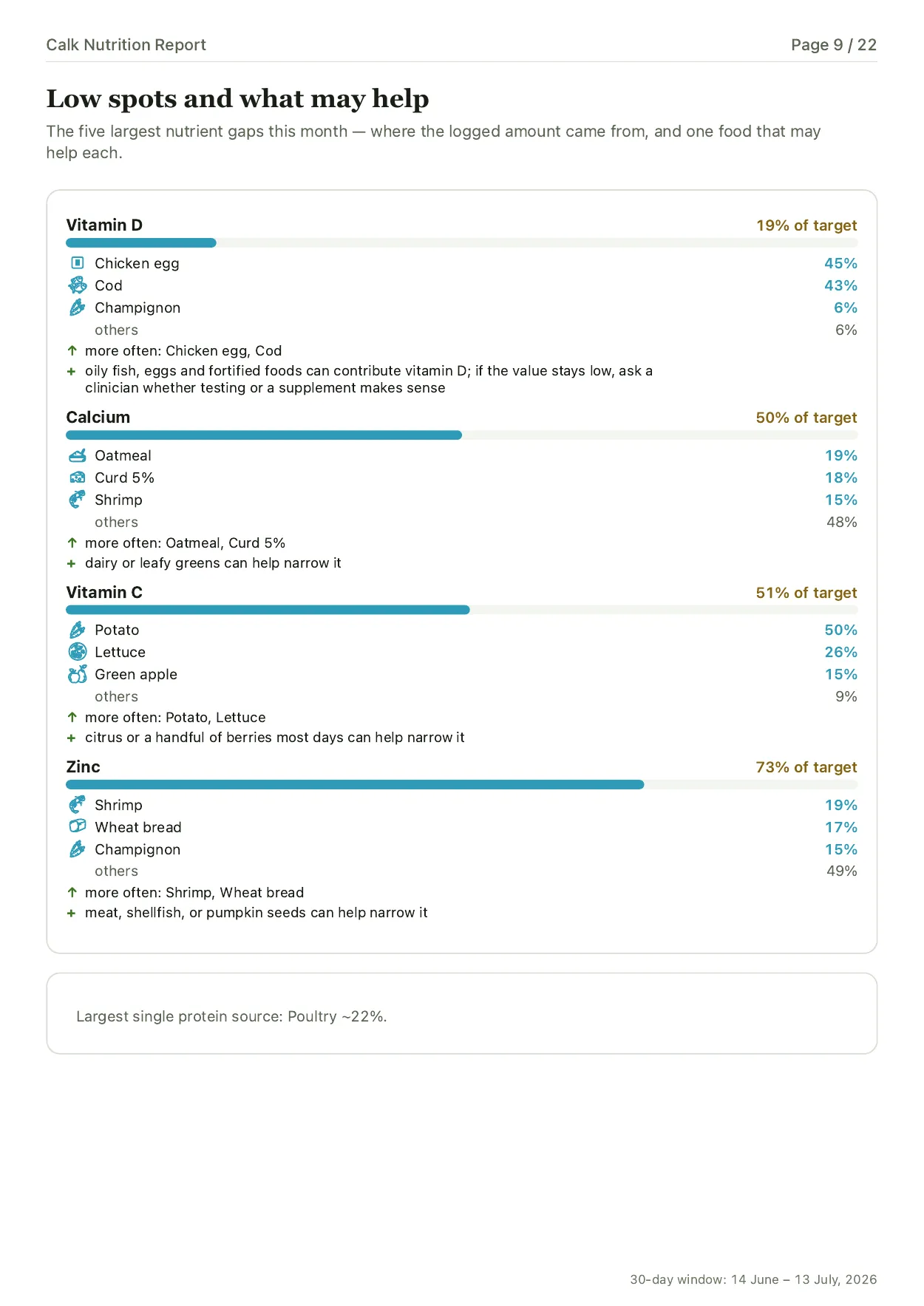
All this work produces a simple result in the app: one baked salmon, one boiled salmon, one fried salmon. A meal template can reuse those same ingredient options, recalculate the entire dish when one choice changes and retain enough detail for the monthly report.
What it still cannot know#
- Your exact portion. Calk can make the food model clearer; it cannot see how much you ate.
- A hidden restaurant recipe. Oil, sugar and ingredient proportions that nobody observed remain estimates.
- The exact label of every brand. For one specific package, a current and correctly entered label can be more exact than a generic food model.
- Every regional food. The catalog is still growing. If an ingredient or meal is missing, write to support@calk.me.
Calk sorts the sources before the number reaches you, keeps incompatible foods apart, checks the assembled meal and names the remaining unknowns. That is how the catalog stays small without relying on a single data source.