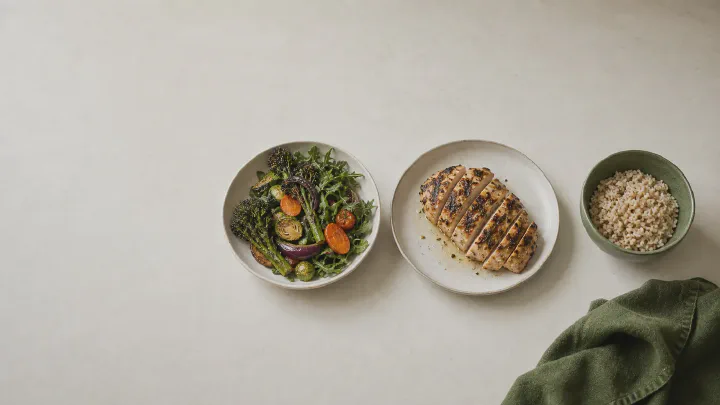
If you’ve read that eating vegetables before carbohydrates flattens the post-meal spike, the short answer is: yes, that effect is real and measurable — and it’s one of the few food-order moves with good evidence behind it. In a study using continuous glucose monitoring, eating vegetables before carbohydrates produced smaller post-meal glucose excursions than the reverse order, in people with and without type 2 diabetes (Imai 2013). You change nothing about what is on the plate — only the sequence — and the same meal lands a little more gently.
But before that becomes another rigid rule, it’s worth understanding what’s actually happening, where the popular “glycemic index” idea breaks down, and which levers reliably steady your energy versus which ones mostly sell books. This is a food-pattern article, not a medical one — and that distinction matters, so we’ll be clear about it throughout. Calk reads the food you build, not your blood.
What glycemic index and glycemic load actually mean#
Glycemic index (GI) ranks a carbohydrate food from 0 to 100 by how quickly and how much it raises blood glucose, compared to pure glucose. White bread and short-grain rice sit high; lentils, most fruit, and intact whole grains sit lower (Harvard 2024).
The problem with GI alone is that it ignores how much carbohydrate is actually in a normal portion. Watermelon has a high GI, but a slice contains so little carbohydrate that its real-world effect is small. That’s what glycemic load (GL) fixes: it multiplies the GI by the grams of carbohydrate in the serving, so it reflects the portion you’d actually eat (Harvard 2024).
GI vs GL: the portion matters
Illustrative. Glycemic load corrects for how much carbohydrate is really in a serving — which is why a high-GI food in a small portion can matter less than a moderate-GI food in a big one.
At the population level, this isn’t trivial trivia. In a large meta-analysis of prospective cohorts, higher dietary glycemic index and glycemic load were each associated with a modestly higher risk of developing type 2 diabetes over time (Livesey 2019). That’s an association across many people and many years — not a verdict on any single meal, and not something a food app can diagnose or prevent.
Why GI is a weaker tool than it sounds#
Here’s the limit nobody puts on the label: glycemic index is measured on a single food, eaten alone, on an empty stomach, in lean fasted volunteers. That is almost never how anyone eats. Real meals are mixtures — the rice arrives with chicken, oil, and vegetables — and the moment you mix foods, the tidy GI number stops predicting much. The fat, protein, and fiber on the plate slow the whole meal down, and the same person can respond differently to the identical food on two different days.
So GI is a useful concept for understanding carbohydrate quality in the abstract, and a poor tool for engineering a specific meal. The good news is that the things that genuinely steady a meal are simpler and more robust than memorizing a GI chart — and they’re about composition and order, not lookup tables.
The real levers: order, pairing, and carb quality#
Three moves do most of the work. None of them require an app to read your blood, and all of them are just descriptions of how you build the plate.
1. Order: lead with vegetables or protein, finish with the carbs#
This is the lever behind the headline. When vegetables or protein go first and the starch follows, the post-meal glucose rise is measurably blunted compared to eating the carbohydrate first (Imai 2013). A protein “preload” shows the same direction: in adults with type 2 diabetes, a small whey-protein drink before a meal lowered the post-meal glucose response, partly by changing how insulin was handled (Smith 2023).
The mechanism is intuitive: food eaten first slows how fast the stomach empties, so the carbohydrate that follows arrives more gradually rather than all at once. The practical version is almost embarrassingly simple — eat the salad before the bread, the chicken before the rice. Same plate, same calories, gentler curve.
2. Pairing: never send fast carbs in alone#
A pile of fast, low-fiber carbohydrate on its own gives the biggest, briefest push. The same carbohydrate alongside fiber, fat, or protein arrives more slowly and tends to leave fullness steadier (Reynolds 2019). This is most of what the old “fast carbs vs slow carbs” idea was groping toward — it was never really about the carb in isolation, it was about its company.
- Toast → toast with eggs and avocado.
- White rice → rice with chicken and a vegetable.
- Fruit → fruit with a handful of nuts or some yogurt.
- A sweet → a sweet after a balanced meal, not on an empty stomach.
3. Carb quality: prefer the higher-fiber version#
Where you can, the higher-fiber form of a carbohydrate behaves better on its own terms. Fiber means less digestible carbohydrate per bite and slower digestion, so blood glucose rises more gradually (Harvard 2024). Across large reviews, higher-quality, higher-fiber carbohydrate is tied to better long-term health fairly independently of total grams (Reynolds 2019), and dietary guidance points the same way (World 2023, Institute 2005). Intact whole grains, legumes, and whole fruit do the work here — not because refined carbs are forbidden, but because the whole-food version comes with the brakes already installed.
The three reliable levers, roughly ranked by how robust the evidence is
Illustrative ordering, not a score. All three help; carb quality and pairing have the broadest evidence, and meal order is a smaller, real, free add-on.
Where Calk fits — and where it deliberately stops#
This is the part to be precise about. Calk does not measure, manage, or predict your blood sugar. It has no glucose sensor, it is not a continuous glucose monitor, and it cannot diagnose, prevent, or treat diabetes or prediabetes. Anything in this article about glucose is general education drawn from the cited research, not a reading of your body.
What Calk can see is the food — and the three levers above are all visible in the food, because they’re really just facts about composition:
- Because Calk reads a meal as its parts (see how the Meal Builder works), it can show you the carbohydrate quality of what you build — the whole-grain and higher-fiber share versus the refined-and-fast share. That’s the carb-quality view.
- It can flag when a meal is almost all fast carbohydrate with little protein, fat, or fiber to slow it down — the meal carb-concentration lens — which is exactly the kind of plate that the pairing lever fixes.
- It can read how your fast carbs are spread across the day versus piled into one large serving, the carb-balance view.
In other words, Calk doesn’t watch your glucose; it helps you build plates that the research associates with a steadier response, and then leaves the body to the body. If you want the broader picture of how it reads sugar and carbohydrate as a pattern rather than a single food, that’s the sugar and carb steadiness theme, and the practical swaps that usually follow are in smart swaps.
Putting it on a real plate#
None of this needs a chart or a rule book. A version you can actually keep:
- Start the meal with the vegetables or the protein. The salad, the soup, the chicken — whatever’s there — before the bread or rice.
- Don’t let a fast carb travel alone. Give it some protein, fat, or fiber for company.
- Choose the higher-fiber form when it’s easy. Whole-grain over white when you genuinely prefer it; legumes and whole fruit do this for free.
- Spread the carbs out rather than loading them all into one big evening plate, if that fits your day.
That’s the whole protocol. It’s free, it requires no device, and it’s the same advice whether your goal is steadier afternoon energy or just a calmer relationship with carbohydrates.
Frequently asked#
Does eating vegetables before carbs really lower blood sugar spikes?
Is glycemic index a reliable way to choose foods?
What’s the difference between glycemic index and glycemic load?
Can Calk track my blood sugar or glucose spikes?
Does this help with diabetes or prediabetes?
The takeaway#
Glycemic index is a real idea with narrow legs: it’s measured on lonely foods and stumbles on the mixed meals people actually eat. The levers that hold up are simpler — eat vegetables or protein before the carbs, never send fast carbs in without fiber, fat, or protein for company, and choose the higher-fiber version where it’s easy. Calk can help you see those things in the food you build, because they’re facts about composition. It cannot, and does not, read your blood — and for anything medical, that’s a conversation for a clinician, not an app.