
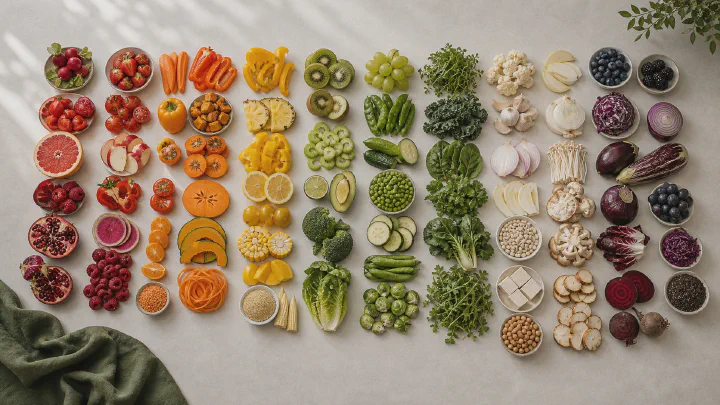
Weight loss requires a sustained energy deficit. Knowing that does not tell you what to cook on Tuesday, how to stay full after lunch or what to do with a food you enjoy.
That is where habits do the work. A useful habit is a meal you can put together with little thought and change when your goal or your appetite changes — not a rule you have to keep believing in.
Start with meals you already eat#
List the meals that appear most weeks: breakfast, work lunch, family dinner, coffee, evening snack. Those repeats decide the month far more than a one-off restaurant dinner.
Pick one of them and ask four concrete questions:
- Is there a real source of protein in it?
- Is there a fiber-rich food, or something bulky and water-rich?
- Which ingredient contributes the most calories?
- Which part can change without ruining the meal?
In a bowl that usually means: keep the rice and the sauce, add more vegetables, settle on an amount of oil, and swap the protein whenever you feel like it. At breakfast: keep the toast, add eggs or yogurt, and decide what the usual amount of butter or spread is.
This is easier to repeat than replacing your whole diet, and it is what public health guidance on changing habits recommends — one small, specific step instead of a general intention to “eat better” National 2021.
Make the meal more satisfying#
If a normal meal leaves you hungry an hour later, a smaller version of it will not help. Look at what it is made of.
| Part | Practical options | What it changes |
|---|---|---|
| Protein | Eggs, yogurt, fish, poultry, tofu, beans | Often improves satiety and helps hold on to lean mass while you lose weight Leidy 2015 |
| Fiber-rich food | Beans, lentils, whole grains, fruit, vegetables | Adds fiber, texture and volume |
| Water-rich food | Soup, vegetables, fruit, potatoes, yogurt | More food on the plate for the same calories |
| Calorie-dense part | Oil, butter, cheese, nuts, dressing, sweets | A set portion does the most work here: a spoon either way moves the whole meal |
The mechanism holds up when it is tested directly. In a controlled feeding study, lowering the calorie density of the food on offer by a quarter took about a quarter off what people ate over two days, and their hunger and fullness ratings came out no different Rolls 2006 Rolls 2017. In a year-long trial, the group counseled to add water-rich fruit and vegetables alongside cutting fat ate a greater weight of food, lost more weight (7.9 kg against 6.4 kg) and reported less hunger Ello-Martin 2007. How this looks food by food is in which foods fill you up for their calories.
Replacement is the key. Protein, fiber and vegetables added on top of the old meal bring calories of their own; if one part of the dish grows, another part usually has to shrink.
Aim all of this at the one meal that keeps leaving you hungry. The meals that already work can stay exactly as they are. For lists of bases, vegetables and fruit, snacks and ready plates, see the most filling foods for their calories.
Keep favorite foods, but give them a clear role#
Chocolate, ice cream, pizza, bread and sweet spreads all fit. The useful question is where the food sits and how much of the meal it carries.
| Food | A repeatable arrangement |
|---|---|
| Ice cream | A bowl after dinner, portioned before you sit down |
| Chocolate | A chosen portion with coffee or after a meal |
| Sweet spread | A set amount on toast, yogurt or fruit |
| Pizza | Pizza as the main event, with a salad or soup beside it rather than a second rich side |
| Burger | Keep the burger; choose the sauce, cheese, side and portion on purpose |
These are examples, not rules. What matters is that the food has an ordinary place in the plan. In the survey work that separated rigid from flexible dietary control, the all-or-nothing pattern went together with more disinhibited eating, while flexible control did not Westenhoefer 1999. The link is an association rather than a demonstrated cause.
Use exercise for what it does well#
Exercise supports fitness, strength, health and long-term weight maintenance Swift 2014. It can also contribute to an energy deficit.
But the calorie number on a workout is too rough to price your next meal. In exercise trials, weight change often comes out below the simple “calories burned” prediction, and individual responses vary widely Thomas 2012 King 2008. Appetite, fatigue and how much you move for the rest of the day all get in the way.
Build the eating pattern so it works on training and rest days. Use exercise to keep the body capable, not to cancel individual foods.
Change the repeated meal, not the whole week#
Suppose a short food check points at weekday lunch. Change one thing for the next week:
- double the vegetables and keep the pasta;
- add chicken, tofu or beans to the salad;
- measure the cooking oil once and make that the normal pour;
- use less of the creamy sauce, or keep it for fewer days;
- add a planned afternoon snack if lunch is followed by hours of grazing.
Then watch three things: hunger, how willing you are to eat that meal again, and the weight trend. If the new version is worse, go back to the old one. A habit earns its place by working every week, not by sounding virtuous.
In Calk that is one edit. Open your saved version of that lunch from the food tab, change the part you are testing and tap Eat; the rest of the dish stays as it was. See what a meal template is.
Use the answers to build habits#
Calk is built for a short cycle:
- Log your ordinary meals long enough for the repeats to show.
- Read Calk’s food observations as the diary fills up; once there is a month behind you, the monthly Nutrition Report puts it together and names the meals and ingredients that carry the most calories, and what the month lacked.
- Change one repeatable part of one meal.
- Check the weight trend for a few weeks to see that it moves the way you planned.
- Once the chosen changes are habits and the trend is going as planned, stop logging food and keep weighing yourself.
- Come back for another short food check when the trend drifts — Calk will tell you when it has.
Among people who keep a large weight loss for years, the same habits recur: a lot of daily movement, a steady eating pattern and regular self-weighing Wing 2005. Weighing is the part worth keeping for good; the food diary is the part you pick up when you have a question. Read the complete loop in how to maintain weight without tracking every day.
What you end up with is a small set of meals you enjoy, understand and can change without starting over.
Calk is available on iPhone, iPad, and Android.