
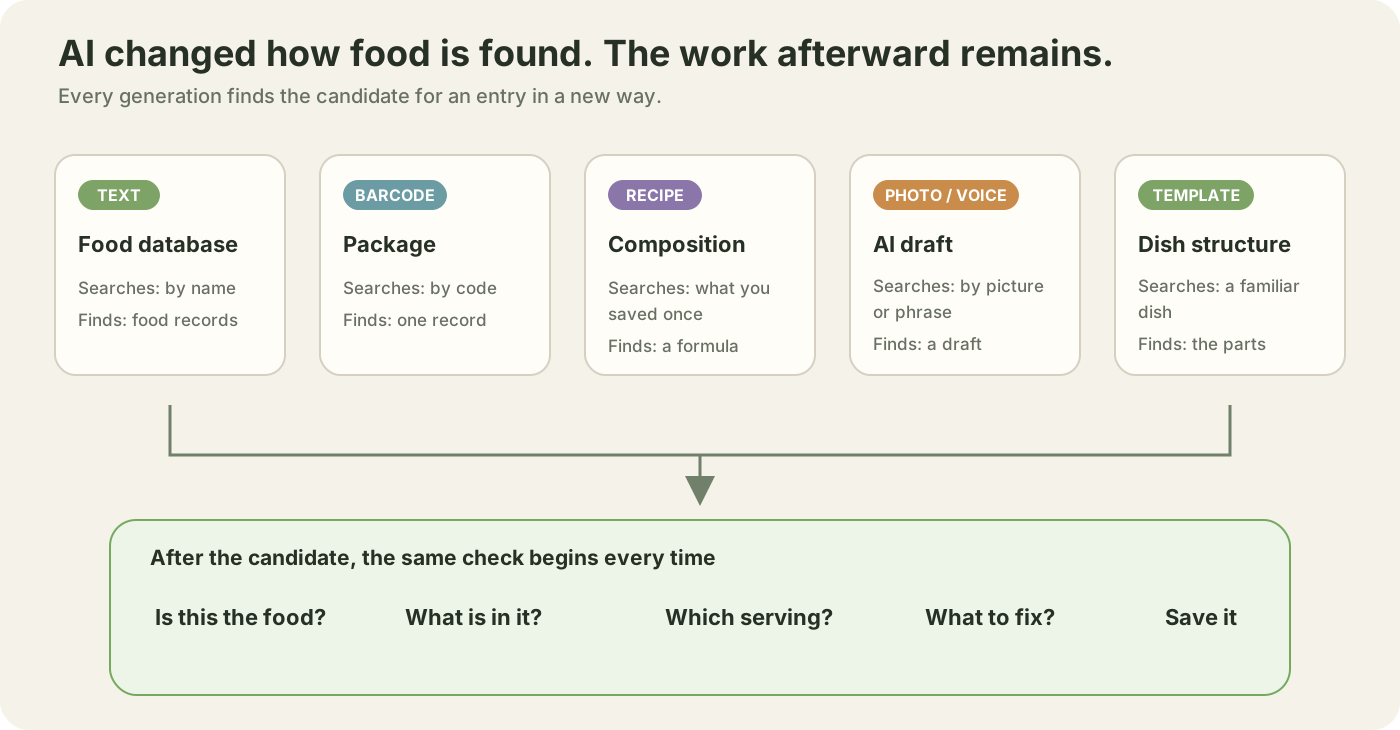
Almost the entire history of calorie trackers is a history of search. First you typed the name of a food into a database. Then barcodes found the exact package, while recipes and recent entries brought back saved meals. Photo and voice logging do the same job in a new way: the query is a picture or a phrase, and the result is still a candidate you have to check.
So “how fast the app found the food” is only the beginning of a comparison. After that you still decide whether it is the right record, what the serving was, what is hidden in the sauce, and whether tomorrow the same plate has to be assembled from scratch again.
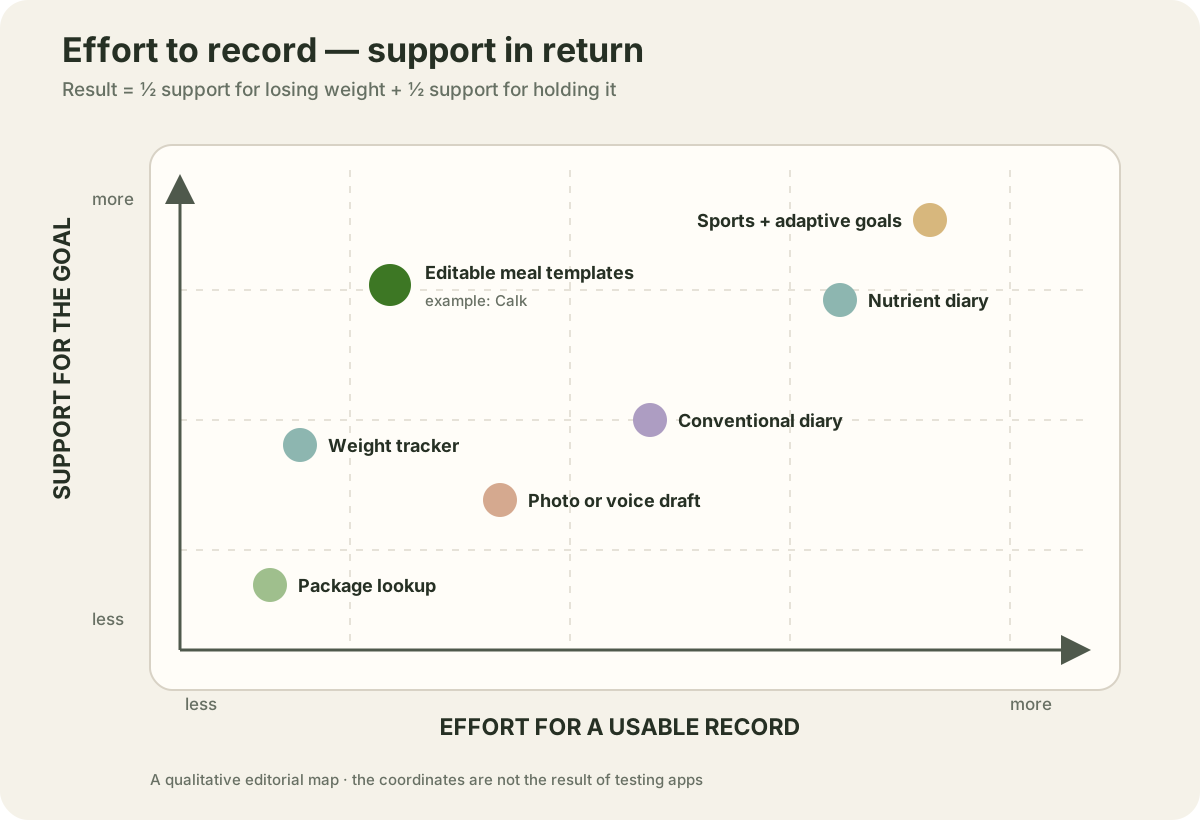
This map compares durable product designs rather than brands by popularity: how much manual work it takes to reach useful feedback, and what the system gives back. We drew its boundaries from open research and first-party product descriptions.
The market map: effort and result#
You cannot compare results without a shared job. Here the job has two halves: lose weight without a blind deficit, and then notice a lasting change without returning to full logging for no reason.
The vertical axis is an editorial composite. Half of the result is support for losing weight: does the system show the repeating sources of energy, the servings, and a change you can actually make? The other half is support for keeping the weight off: does it connect food to the weight trend and help you tell when a change is really needed? This is not a clinical efficacy score or a measured app rating.
Effort for a usable record grows along the horizontal axis: search, choosing the record, the serving, checking the composition, corrections, and rebuilding a dish that changed. How long the diary has to continue is deliberately left out — that is a separate life-cycle axis at the end of the article.
 Open full size ↗
Package lookup takes little work and answers a narrow question. A nutrient or sports diary can give deeper feedback, but it needs detailed and regular data. Photo AI shortens the path to a draft, though checking the ingredients and the serving can hand some of that work back.
Editable meal templates occupy a place of their own. They do not try to guess the plate again every time: the system remembers how it is built and, on the next entry, asks you to mark only the difference. Calk is an example of that design. A template reduces the work on a repeat, but it does not set the diary’s duration: even a fast repeat can continue for years.
How the market reached AI#
New ways in did not replace the old ones — they piled on top of them. The database removed manual arithmetic. The barcode replaced a search by name with an exact package identifier. Recipes let people save a recurring combination once. Photo and voice learned to produce a first draft from an image or a phrase.
 Open full size ↗
A review of 117 publications described 129 smartphone dietary-assessment tools and identified five recurring mechanisms: photographs, portion assessment, free text, food databases, and classification. On average a tool combined two of them.1 The market did not move from “the old search” to AI: it added AI on top of databases, serving rules, and the check at the end.
Calk has no barcode, no photo AI, no voice input, and no millions of search results. Adding more ways in no longer solves Calk’s main job: familiar food should not be guessed again — it should be saved once, in a form that is easy to correct.
The real difference: what the app remembers until tomorrow#
The first entry is what the advertising shows. Day to day, what the app lets you reuse matters more.
| Design | What the first entry finds | What is left for next time |
|---|---|---|
| Database search | a record for a food or a dish | the chosen record in your history; the serving and the combination often have to be rebuilt |
| Barcode | the record for one specific package | the exact product; a new serving and the rest of the plate stay separate |
| Recipe | a fixed list of ingredients | a ready formula; changing the composition means editing the recipe or making a new version |
| Photo or voice | a draft proposed by the system | the recognition result; its accuracy and repeatability depend on the check |
| Editable meal template | the structure of a bowl, a porridge, or a salad | the usual parts and the serving; on a repeat only the difference changes |
In Calk’s scenarios search really did turn out to be a one-off part of the work. A first banana entry costs four taps, a vegetable lasagna three, a salmon and quinoa bowl five. From your own tab each of those dishes is one tap cheaper. A dinner of three separate dishes is twelve taps on the first entry and nine on a repeat. See on one scale exactly where the extra work disappears: from a banana to a three-dish dinner.
Depth, country, and real food#
Two diaries built the same way can account for entirely different amounts of information.
Every zone has three further independent dimensions:
- Data depth: from calories and macros to fiber, sodium, micronutrients, and supplements.
- Database proximity: from generic foods to national dishes, local brands, retail chains, and your own recipe.
- Coverage of real food: a package can be found by barcode; a home plate, a soup, or a restaurant dish has to be described by its parts, a recipe, or an explicit assumption.
Depth raises the demands on provenance. If the source record has no fiber, sodium, or vitamin value, the daily report cannot reconstruct it — it can only add up the fields that are there. A systematic review of validation studies of dietary-record apps found substantial heterogeneity in results and methods; the choice of composition table noticeably affected the discrepancies.2 Calk builds a compact catalog from national composition tables, scientific publications, labels, and recipe sources, and checks prepared dishes separately.
Country lies across the whole map. A barcode helps when the code leads to a current record for that particular market. A study of seven apps on 100 products from two Dutch retail chains found strong identification in some apps alongside noticeable gaps in particular nutrients; those results cannot be transferred automatically to another country or year.3 Even the right name can return several plausible values — that is the calorie-database lottery.
A barcode answers “what is written on this package?” well. Yesterday’s stew, a home bowl, or a restaurant curry cannot be scanned. Calk starts from the recognizable structure of a dish and keeps its parts, its serving, and its assumptions visible and correctable.
For an ordinary plate the exact weight often does not change the decision: it matters more to see the big parts and the hidden extras. A separate guide shows how to judge such food without kitchen scales.
The best calorie trackers in 2026 — for which job?#
The word “best” means something only together with a job.
| Job | Examples | What you get | What you pay |
|---|---|---|---|
| Exact packages, recipes, and integrations | MyFitnessPal, YAZIO and FatSecret | search, barcode, custom foods and recipes | quality depends on the record and the country; the diary has to continue |
| A sports goal and continuing macros | MacroFactor, Carbon | regular feedback and target adjustment | without regular entries the loop loses its input |
| Micronutrients, supplements, a special diet | Cronometer, Carb Manager | a deeper nutrient ledger | more fields to verify; a gap in the source can look like a low total |
| A fast draft from photo or voice | Cal AI, Foodvisor | less searching and typing at the first step | the serving, the hidden ingredients, and the mistakes may still need checking |
| Local food and packages | Asken, Boohee, Fitatu, FDDB, INOUT | the language, dishes, brands, and servings of one market | coverage is usually weaker outside the home market |
| Change your usual diet and finish the diary once the changes are habits | Calk | a short food check, a report, and a weight trend afterwards | not a substitute for a catalog of exact packages or a permanent sports protocol |
The table includes products whose own materials directly describe the design or the local specialization that their row names. These are example positions, not a full catalog of the market.
Why photo and voice are not an automatic answer to fatigue#
AI entry solves a real problem: an empty field turns into a draft faster. In a randomized study of 42 young adults, a research system using image plus voice recognized dishes more accurately and completed reporting faster than a voice-only version. But the study worked with a menu of 17 dishes and did not measure calorie accuracy; it is evidence of faster reporting in a specific workflow, not of universal accuracy for photo trackers.4
A systematic review of 52 papers on image-based food analysis found datasets and measures too heterogeneous for a single pooled accuracy figure; simple food was generally easier for these systems than complex dishes.5
Keep two claims apart:
- “The photo produced a draft faster” — quite possible.
- “The photo took all the work off me” — that depends on how much had to be checked afterwards.
AI makes the search easier. Checking the recognized foods, the serving, and the hidden ingredients stays on the next screen. For a burned-out user this is decisive: a fast draft helps only when it shortens the whole path to a finished record. The limits of the measurements are covered in the article on the accuracy of photo calorie counting.
Why a local database sometimes matters more than AI#
Open food-data sources already show why a “global database” is never the same in every country. Open Food Facts offers an open API with products, ingredients, and nutrients, and it can filter records by country; the database is filled by its community.6 USDA FoodData Central publishes American branded foods under CC0.7
A local app knows the familiar packages, retail chains, names, and servings better. The table below lists what a “global database” misses in each market and which local app fills that place; the examples repeat what each company says on its own pages:
| Market | What is local about it | Example of a local app |
|---|---|---|
| Japan | rice-based set meals, miso soup, bento portions, convenience-store packages | Asken: Japanese dishes, barcodes, photos, and a program with daily feedback |
| South Korea | kimchi and banchan side dishes, bowls of rice and soup, Korean packaging | INOUT: Korean food, language, and local scenarios |
| China | stir-fries shared from the middle of the table, dumplings, congee, regional cuisines | Boohee: a Chinese database and a weight-management program |
| Israel | hummus and salads by weight, shakshuka, white cheeses by fat grade, the Friday dinner, kosher product lines | Kaloria (קלוריה): Hebrew interface and database, 60,000+ local foods, barcode scanning |
| Germany and DACH | bread and sausage varieties, Brotzeit, dairy by fat grade | FDDB: the app lets you choose a country database; the German one holds noticeably more products |
| Poland | pierogi, soups as a course, cottage cheese and kefir, local retail brands | Fitatu: Polish products and dishes; a separate choice of country database |
| France | composed dishes such as quiches and gratins, baguette by weight, the cheese course | CompteurCalories: a French database built on the Ciqual/ANSES table, plus French supermarket products |
| Spain | tapas and raciones, the menú del día, olive oil in almost everything | MyRealFood: scans products from Spanish supermarkets and breaks down what is in them |
| Latin America | tortillas, arepas, tacos and empanadas, street-food portions, rice and beans as a base | Fitia: nutrition data compiled for Latin America and Spain |
| Brazil | rice with beans as the base of the plate, feijoada, pão de queijo, açaí bowls | Tecnonutri: Brazilian meal plans and support from nutritionists |
| United Kingdom | supermarket ready meals and meal deals, Sunday roast, sandwiches by the pack | Nutracheck: a UK database of 500,000+ items, from the supermarket chains to the high-street cafés |
| Türkiye | mezze, pide and börek, yoghurt-based dishes, tea and simit between meals | Diyetkolik: a Turkish platform with a dish database and dietitian plans |
| India | thali and dal with roti, regional vegetarian cooking, sweets, portions in spoons and ladles | HealthifyMe: a catalogue of Indian dishes and photo recognition trained on Indian food |
The practical test is simple: find five products from your basket, one local dish, and one home recipe. Translating the menu without those records does not yet create a local database. Calk’s scenario corpus covers typical diets of thirteen countries, including the USA and the UK; the method and the composition of the corpus are shown in the tap measurement.
Fast logging can still last forever#
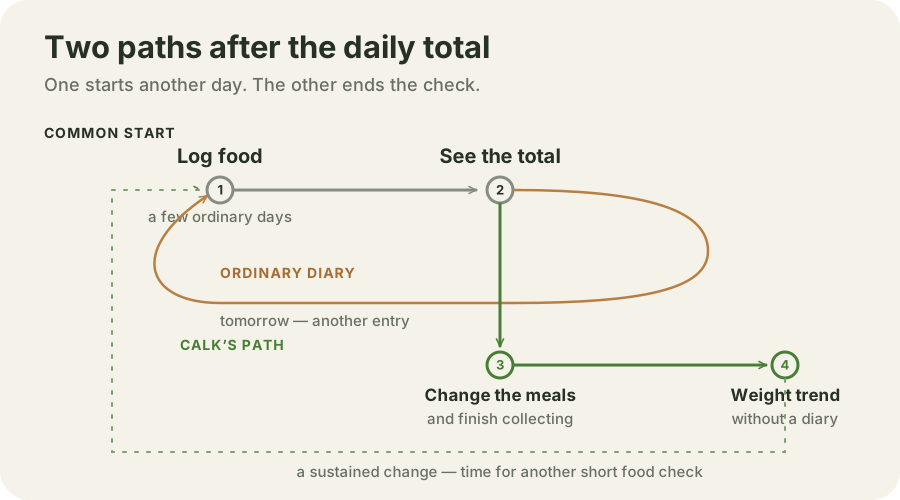
Everything above was about a single entry. But an app can speed up every entry beautifully and still need a new one tomorrow, the day after, and a month from now. An ordinary diary ends the day with a total — and starts the same cycle again.
Calk adds the missing part to that cycle — changing the food. A short food check collects ordinary days, and the analysis shows the repeating meals and what to add or replace in them. Keep logging as you put the changes into familiar recipes. Once they are habits, daily logging ends: there is no separate rule to remember at every meal. What is known about those changes, and where the evidence stops, is covered separately.
New measurements keep updating the weight trend; a lasting drift away from your intended direction becomes the reason for the next short food check rather than for open-ended logging.
 Open full size ↗
For a precise sports goal the permanent cycle can be the product itself: new entries update the recommendations. Calk is built for a different job — understand your ordinary eating, build useful changes into habits, and stop living in the diary. When to come back to a short food check after losing weight is covered in the article on maintaining weight without daily counting.
Calk is available on iPhone, iPad, and Android.



Frequently asked questions#
Which calorie tracker should I choose if I am tired of keeping a food diary?
Do photo and voice really reduce the effort?
What is best for packaged food?
What is best for sports and precise macros?
What is best for micronutrients or keto?
Why does the country matter when choosing a tracker?
Can I stop counting calories every day?
Sources and the limits of the map#
The map describes product designs, not popularity, company quality, or medical suitability. The examples and the first-party pages were checked on September 7, 2026; features and availability vary by country and plan. No app-store positions, download or revenue estimates, or derivatives of paid market-intelligence services were used. The map may be quoted and reproduced with a link to this page.
König LM, Van Emmenis M, Nurmi J, Kassavou A, Sutton S. Characteristics of smartphone-based dietary assessment tools. Health Psychology Review. 2022;16(4):526–550. ↩︎
Zhang L, Misir A, Boshuizen H, Ocké M. A Systematic Review and Meta-Analysis of Validation Studies Performed on Dietary Record Apps. Advances in Nutrition. 2021;12(6):2321–2332. ↩︎
Maringer M, Wisse-Voorwinden N, van ’t Veer P, Geelen A. Food identification by barcode scanning in the Netherlands. Public Health Nutrition. 2019;22(7):1215–1222. The sample: 100 products from two Dutch retail chains; the results do not transfer automatically to other markets and years. ↩︎
Sahoo PK, Chiu SYH, Lin YS, et al. Automatic Image Recognition Meal Reporting Among Young Adults. JMIR mHealth and uHealth. 2025;13:e60070. Different groups were compared: image plus voice, n=22, and voice input, n=20; the study did not measure calorie error. ↩︎
Shonkoff E, Copeland Cara K, Pei XA, et al. AI-based digital image dietary assessment methods compared to humans and ground truth. Annals of Medicine. 2023;55(2):2273497. ↩︎
Open Food Facts API documentation and licensing terms. The database is open under ODbL; images have separate terms. ↩︎
USDA FoodData Central API and licensing and Global Branded Food Products Database. FoodData Central data are published under CC0; coverage of branded foods depends on the market and the suppliers. ↩︎