
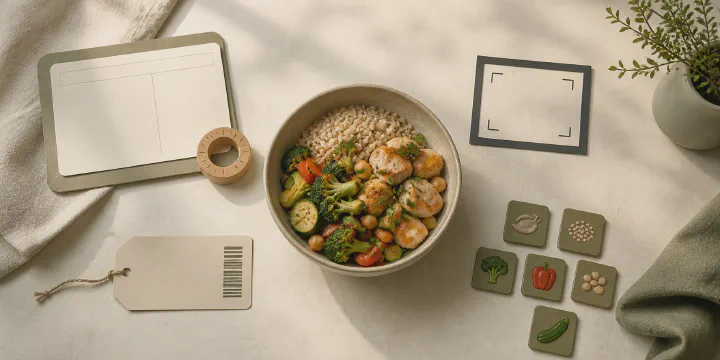
The photo is taken, the code is scanned, the plan for the day is open. The first gesture took seconds. The question is what month two looks like.
YAZIO combines a diary, goals, recipes, activity and intermittent fasting.1 Cal AI starts logging from a photo of the plate.2 FatSecret gives you a classic diary with a free barcode scanner and a community.3 All three are built on the assumption that you will keep logging.
Calk is built on the assumption that you will stop.
How it ends in Calk#
This is worth explaining before the comparisons, because the other three are not built this way.
- You log ordinary food for a month. Not a model week: weekdays, weekends, delivery, dinner in a café.
- Calk takes the month apart. Food observations point out what stands out in your recent days. The monthly Nutrition Report puts the whole month together: what your calories and protein rest on, which food groups never appear at all, how this month differs from the last one.
- You change the meals you already eat. Not the whole diet — one or two recurring dishes that are pulling the result.
- Once all your chosen changes are habits and your weight trend is on track, daily food logging ends. Your saved meal templates wait for next time.
- You keep weighing yourself. The trend smooths daily fluctuations and shows where your weight is heading.
- Come back for a reason. The weight trend moved, the routine changed, the season turned. A week of entries is enough to fill “Food variety this week” again and show which of the fourteen food groups dropped out.
Calk has no streaks, no red days and no daily reminders. The only food-related notification appears if the weight trend has drifted seriously and persistently.
The limits that search, barcodes and photos share are covered in how Calk differs from ordinary trackers. Below are only the differences between these four apps.
Calk and YAZIO: a program for every day, or a month with an end#
YAZIO gathers several jobs into one product: a diary, barcodes, photo recognition, fasting timers, a recipe catalog, activity sync. A target seen every day, meals planned from recipes and a fasting timer are its job, and Calk does none of it.
The difference that decides is elsewhere. YAZIO’s program is built to be maintained: the plan needs continuing, the recipes need choosing, the timer needs attention. Calk is built to give you those months back.
Calk and Cal AI: a photo, or visible assumptions#
A photograph does not show what the number is made of. You cannot see the oil that went into the pan, the sugar in the sauce, the fat content of the meat under the crust or the depth of the bowl. The model returns a confident result anyway — usually to the kilocalorie.
That confidence has been measured. From a single picture, strong models are off by 20–36% of a dish’s calories on average; in an NIH test on 102 meals, four consumer apps, Cal AI among them, missed 27–38% of the meal on average. The tests, the methods and the open data behind those figures are in how accurate photo calorie counting is.
Then comes the unpleasant part: checking that result is your job, using knowledge about the dish that you opened the app to get. For an apple or a slice of bread the check costs nothing. For a mixed dish — a soup, a curry, a bowl — taking someone else’s number apart and correcting it can be more work than building your own from scratch: first you have to work out what the model assumed, and only then decide what is wrong with it.
In Calk the assumptions sit in the interface. In a bowl you see the base, the protein, the preparation, the fat, the sauce and the portion separately. You see what the number is made of, and you change the part that is different today.
Calk and FatSecret: a classic diary, or a meal template#
FatSecret’s free core includes a food and weight diary, macros, barcodes and a community. For supermarket packages that is convenient: if you eat yogurt, bread and ready-made products with current codes every day, a free scanner solves the task faster than any template.
Calk’s main scenario is different: the food has no barcode, but it changes inside a familiar shape. The soup got thicker, the curry has a different sauce, the bowl has a different protein and dressing. A template keeps those parts editable instead of turning every variant into a new database row.
First the duration, then the way in#
There is one question the entry methods do not settle: how many months you intend to keep entering food. For YAZIO, Cal AI and FatSecret the answer is the same — as long as you want the picture. The diary is the product there.
So the first question is not “where is entry more convenient”. If logging feels manageable and you expect to keep doing it for years, pick the entry method that suits what you eat, and check the estimate when it came out of a camera.
If collecting the data should finish — understand your eating, change what is worth changing, and stop logging every day — then of these four that scenario exists only in Calk: a month of ordinary food, a report, changes to the dishes you already eat, then daily logging ends once those changes are habits. The weight trend continues from weigh-ins.
The estimate does not have to be exact to do that work. An approximate entry you keep making all month tells you more about your eating than a gram-accurate diary abandoned in week two.
Take one meal that repeats often but is rarely exactly the same. If it comes in a package, a scanner is the shortest path. If the sauce, oil, preparation or portion change, build the ordinary version in Calk and on the next repeat correct only the difference.
Calk is available on iPhone, iPad, and Android.



Frequently asked questions#
Is it worth counting calories from a photograph?
Who has a free barcode scanner?
When should you choose YAZIO?
Which of the four lets you stop logging every day?
Sources and review date#
Features were checked on September 5, 2026 against YAZIO’s official website and the Cal AI and FatSecret App Store listings. The feature set depends on country, platform and plan. Prices are not compared: they differ across markets and offers.
Cal AI on the App Store, checked on September 5, 2026. ↩︎
Calorie Counter by FatSecret on the App Store, checked on September 5, 2026. ↩︎