
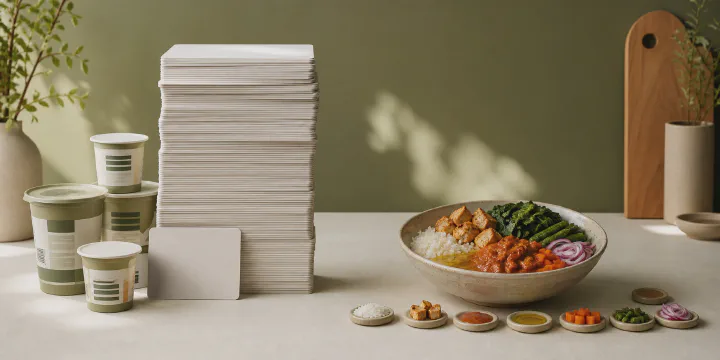
You logged this curry yesterday. The day before, too. Today it has a different sauce — and MyFitnessPal offers to find it in the database again.
It comes down to the unit of logging. In MyFitnessPal you log a row: a food found by search, scanned from a code or created by hand. Several rows can be saved together as a Meal, and it comes back exactly as you saved it — same foods, same grams. Change the sauce and you have to open the set and rewrite it line by line.
In Calk, yesterday’s ingredients are already selected. Change only today’s sauce: the chicken, rice and portion stay in place while the meal recalculates.
Today’s difference goes in by editing rows: find the right one, swap the food, redo the grams.
Coconut sauce becomes tomato in one tap. Chicken, rice and portion stay selected.
The difference shows on the second entry#
The first entry looks much the same in both apps: you search for something, pick something, confirm something. After that they part ways.
The same curry shows up three times in a week, and each time it is a little different. In MyFitnessPal you have two routes: pick another plausible row from the database, or edit the saved one. The first quietly changes every assumption at once — the new row was written by a different person from a different recipe. The second is hand work, and the more varied your eating, the more of it there is.
Today’s curry changed
MyFitnessPal’s barcode scanner answers the question “which package is this?” — and it answers it well, when the entry for your product is current. But that is a question about the supermarket shelf rather than your kitchen, and the scanner is a Premium feature.1
Three cases where searching the database does not help#
A large database helps only when your food already has a name that somebody wrote an entry for. Everyday food often has no such name.
A chocolate bar that is not in the database. A local brand, a regional launch, a bar from a vending machine. Search returns a dozen similar names with different numbers, and choosing between them is left to you.
A restaurant dish. Portion, oil, sauce and size belong to that kitchen. A row called “pad thai” describes somebody else’s pad thai.
A homemade dish you did not weigh. MyFitnessPal has a recipe builder, and it asks for ingredients, their quantities and a number of servings. You can give the quantities by eye, in cups and spoons, and the recipe will then be exactly as accurate as those guesses. One guess per ingredient, made again whenever the pot comes out different.
If it is the library you have built that keeps you from switching, here is what MyFitnessPal actually lets you export — and how to leave without rebuilding it.
Calk is built for exactly those three cases. A template records how a familiar dish is put together and keeps the assumptions in view: which protein, how it was cooked, how much fat, which sauce, what portion. The number comes out approximate, and says so, instead of borrowing the gram-level precision of somebody else’s recipe.
How much precision you need depends on the question. If you are working out what your ordinary diet rests on, the difference between “about 640 kcal” and “about 690 kcal” changes no decision: patterns that size are larger than the error. And an estimate you keep making for a month tells you more than a gram-accurate diary you abandon in week two. Where grams genuinely decide something — contest preparation, or counting carbohydrate to dose insulin — you need the label or the scale, and for insulin a plan agreed with a clinician; an estimated dish does not do that job in any app. What approximate estimation can and cannot do is in counting calories without weighing.
Fiber, vitamins and minerals from the meal’s ingredients#
A MyFitnessPal row contains exactly the fields its author entered or the manufacturer supplied. Some rows are reviewed by the team — but the company itself warns that a reviewed entry can still be wrong.2 A field nobody filled in shows up in the diary as a zero.
In Calk, fiber, vitamins and minerals live in the ingredient itself rather than in a diary row. Lentils bring their fiber every time they land in a meal — regardless of whether they came in a package, whether the country requires fiber on the label, and what a stranger typed into a database.
A particular loaf of bread or batch of grain can differ from the reference value, and Calk measures and publishes that: the spread is wider for fiber, salt and sugar than for calories. But differing is not the same as turning into a zero.
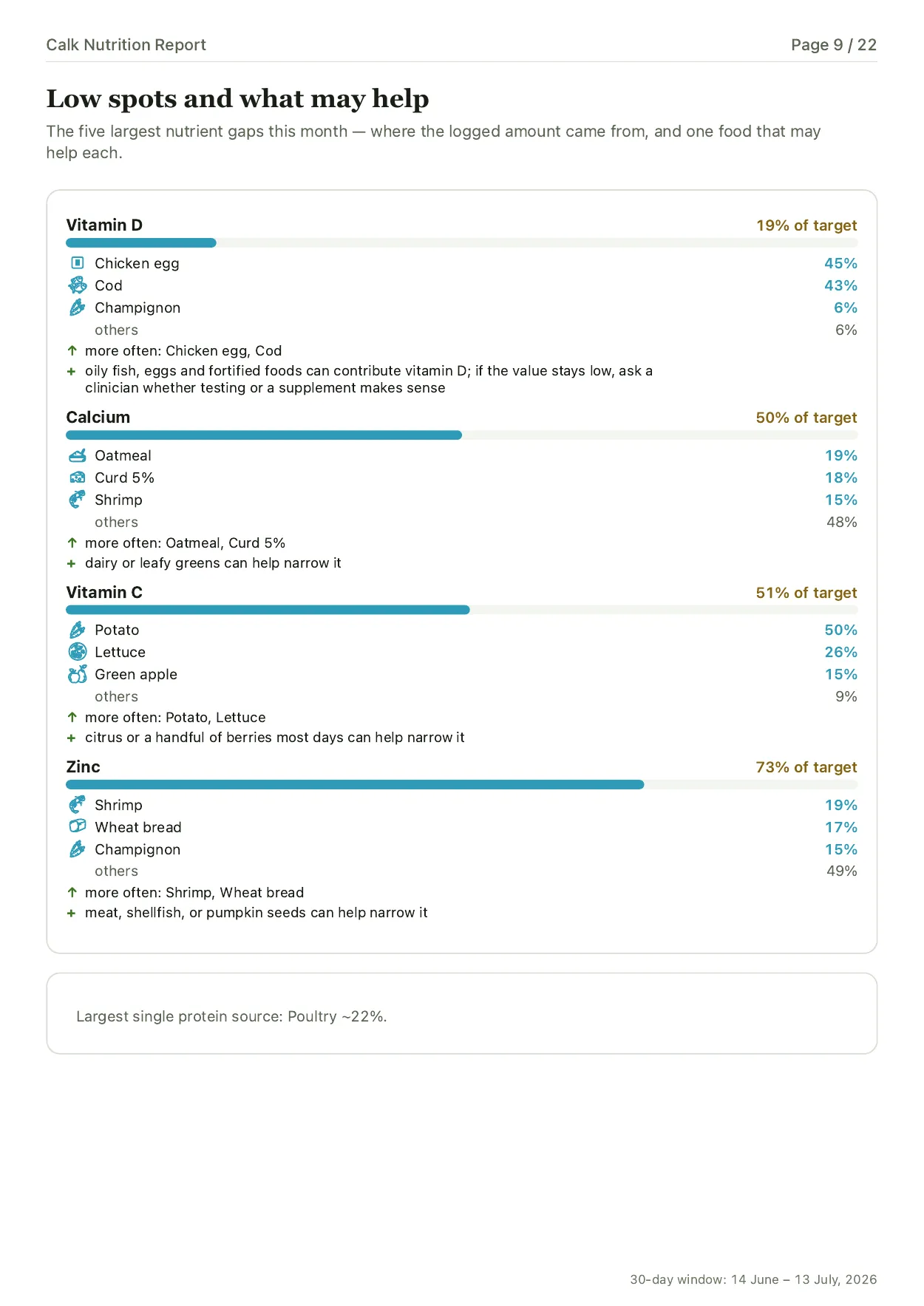
Everything that happens afterwards rests on this. A report can name the foods that carried each nutrient for you all month only if those foods stayed foods in the record, instead of becoming a row that says “dinner, 700 kcal”.
 Open full size ↗
What is free#
MyFitnessPal’s free tier is a manual diary with ads; photo recognition and voice logging sit behind Premium alongside the scanner.1
Calk keeps food logging, daily calorie and macro targets, weight entry, the trend chart and a shareable seven-day Variety Map free — and with no ads, on any plan. A new account opens with 30 days of full access and no bank card required. See how to get your monthly Nutrition Report for the food and weight records it uses.
A diary you do not need every day#
There is a difference that matters more than any feature list. MyFitnessPal is built on the assumption that you will keep logging: streaks, reminders, a daily goal. Calk is built on the assumption that you will stop.
The order is this. For one month you log ordinary food. Food observations point out what is worth a look in your recent days, and the monthly report puts the whole month together: the dishes that come back, where the calories come from, what to change first. You put the changes into your usual dishes and keep logging until each one becomes a habit. That is when the daily diary ends.
Come back for a reason, not for a notification. A weight trend that has drifted and stayed there is a reason. A change of season, and with it half of what you buy, is also a reason, and a week is enough: “Food variety this week” fills up from your own entries and shows which of the fourteen groups did not appear that week.
MyFitnessPal has many ways in: search, barcode, photo, voice, custom foods and recipes. The price is known in advance: every entry costs time, every day, for as many days as lie ahead.
Calk is built for a different case. The familiar meal is already assembled — the only thing to change is what is different today. You do not have to hold its composition in your head either; the template holds it. And the diary has an end.
You can test this over two dinners. Build one meal in Calk — one that changes a couple of times a week. On the next repeat, do not create a new entry — change only the sauce, the preparation or the portion.
Calk is available on iPhone, iPad, and Android.



Frequently asked questions#
How is a Calk meal template different from a saved Meal in MyFitnessPal?
Can you log a meal that is not in the MyFitnessPal database?
Why does a diary sometimes show zero fiber?
What is free in Calk?
Sources and review date#
MyFitnessPal’s features were checked on August 11, 2026 against the company’s official help center and website.